


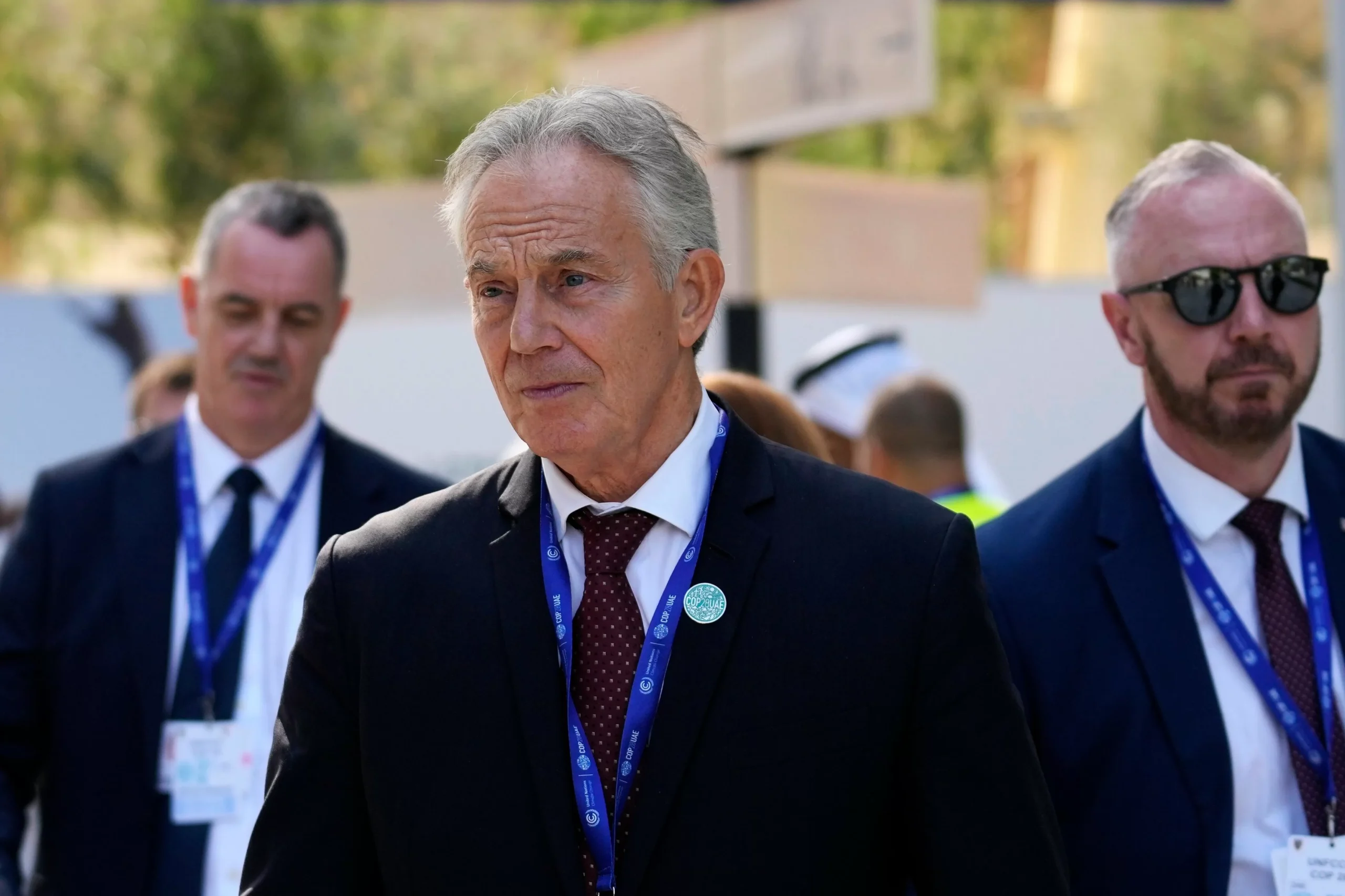
Former Prime Minister Tony Blair sent shockwaves through the political world when he appeared to criticize the push for achieving net zero emissions by 2050 during his appearance at the COP28 UN Climate Summit in Dubai, United Arab Emirates on Sunday, December 3, 2023.
In a foreword to a report by the Tony Blair Institute, the former prime minister stated that political leaders are well aware that the current debate surrounding the net zero policy “has become irrational.” He also went on to say that the government’s plan to phase out fossil fuels is “doomed to fail,” which some saw as a direct dig at the flagship policy of the current government to reduce net carbon emissions to zero within the next 25 years.
Blair’s words came as a major blow to No.10, as Labour leader Sir Keir Starmer is known for sharing many values with New Labour and has sought advice from his predecessor. The Tony Blair Institute quickly tried to downplay the split, claiming that the current government has the “right” approach, but it was too late. The damage had already been done, and the story quickly spread throughout the country, even securing a mention in PMQs.
Let’s take a look at why Blair’s comments completely missed their mark.
A Win for Labour’s Opponents
Despite Blair’s emphasis on the importance of addressing the climate crisis, his words appeared to validate concerns from climate sceptics. For instance, deputy leader of Reform UK, Richard Tice, told ITV’s Good Morning Britain that the party has “newfound fans like Tony Blair” who are in agreement with their anti-net zero policy – although he later admitted he was “teasing.” Even DUP MP Sammy Wilson adopted a similar tone during PMQs, claiming that Starmer’s net zero policy “is not only bad, it is mad” and that even Blair agrees.
However, Blair’s former political secretary, John McTernan, suggested the opposite in an interview with Times Radio, stating that the former PM was simply pointing out that “grievance is the energy source for populist movements.” He argued that Blair was encouraging politicians to engage with people’s feelings in order to deter support for groups like Reform UK, and not that he was against net zero altogether.
While Blair may have won backing from Labour’s opponents, those affiliated with the party had a different view. Unite the Union issued a firm warning, stating that Blair’s intervention on net zero policy must be a wake-up call for the government. General Secretary Sharon Graham said, “Unite is not against net zero, but it cannot be achieved without serious investment in new jobs.” She emphasized that the time to act is now and called on the Labour party to take the lead in making this a priority.
To make matters worse, Blair’s intervention came just before local elections in 23 councils and the Runcorn by-election – the first major test for the current government since their landslide victory in July.
Net Zero is not the Main Concern
Blair’s remarks were also criticized for being “misleading” amidst the already heated climate debate. The Energy and Climate Intelligence Unit (ECIU), an organization that promotes debate on climate policy, stated that “given the clarification that the TBI [Tony Blair Institute] has had to issue, this seems like a bizarre case of naivety on how parts of the media and politicians might misinterpret some of the statements in the foreword.”
Nicholas Stern, Blair’s former climate guru and now the chair of the Grantham Research Institute, called Blair’s report “muddled and misleading.” He further stated, “The UK’s leadership on climate change, particularly the elimination of coal from its power sector, is providing an influential example to other countries. So, too, its climate change legislation and its Climate Change Committee. If the UK wobbles on its route to net zero, other countries may become less committed. The UK matters.”
Stern, who launched a landmark report on climate change in 2006 under Blair’s government, has warned that the report “downplays the science in its absence of a sense of urgency and the lack of appreciation of the need for the world to achieve net zero as soon as possible.”
Meanwhile, Bob Ward, policy and communications director at the Grantham Research Institute on climate change at the London School of Economics and Political Science, stated that, “This report provides weak analysis and the wrong solutions. It fails
