

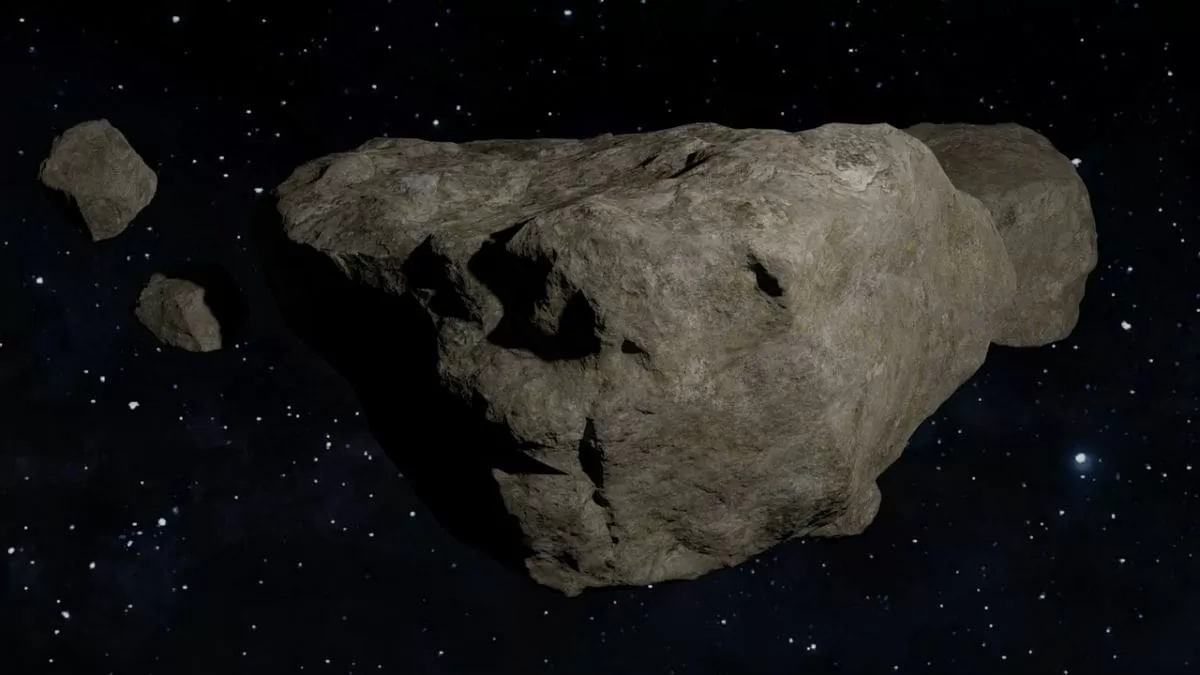
Astronomy enthusiasts and curious minds alike are in for a treat on May 9th, as a 950-foot-wide asteroid named 2002 JX8 will safely pass Earth. The Virtual Telescope Project will be livestreaming this event, starting at 4:30 p.m. EDT, allowing viewers from all over the world to witness this spectacular phenomenon.
The asteroid, which was first discovered in 2002, has been classified as potentially hazardous due to its size and distance from Earth. However, scientists have reassured the public that there is no cause for concern as it will remain over 2.6 million miles away from our planet. This distance may seem close in astronomical terms, but it is considered a safe distance by experts.
The Virtual Telescope Project, founded by astrophysicist Gianluca Masi, aims to bring the wonders of the universe closer to people through live streaming of celestial events. This time, they will be using their powerful telescopes to capture and broadcast the passing of 2002 JX8, providing a unique opportunity for the public to witness this rare event.
The live stream will be available on the project’s website, www.virtualtelescope.eu, and will be accompanied by commentary from experts in the field. Viewers will have the chance to ask questions and learn more about this asteroid and its journey through our solar system.
But what exactly is this asteroid and why is it considered potentially hazardous? 2002 JX8 is a near-Earth asteroid, meaning its orbit brings it close to our planet’s orbit. It was first discovered by the Lincoln Near-Earth Asteroid Research (LINEAR) program, which is dedicated to detecting and tracking near-Earth objects. This particular asteroid has been classified as potentially hazardous due to its size and distance, not because of any risk of collision with Earth.
Potentially hazardous asteroids are defined as those that have a size of at least 460 feet and come within 4.6 million miles of Earth’s orbit. While this may seem like a large distance, it is still considered a close approach in terms of the vastness of our universe. However, scientists have been closely monitoring 2002 JX8 and have determined that it poses no threat to our planet.
In fact, these close approaches by asteroids provide a valuable opportunity for scientists to study these space rocks and learn more about our solar system. By observing their size, composition, and trajectory, researchers can gain a better understanding of the formation and evolution of our universe.
The passing of 2002 JX8 is just one of many close approaches by near-Earth asteroids that occur regularly. While it may sound alarming, it is actually a reminder of the dynamic nature of our solar system and the constant movement of objects in space. Thanks to advances in technology, we are now able to witness these events in real-time, bringing us closer to the wonders of the universe.
So mark your calendars for May 9th and tune in to the Virtual Telescope Project’s live stream of 2002 JX8’s passing. This is an opportunity not to be missed, as we continue to expand our knowledge and appreciation of the vastness and complexity of our universe. And rest assured, there is no need to worry as scientists have confirmed that this asteroid poses no risk to our planet. Let us come together and marvel at the beauty and mystery of our universe.
