

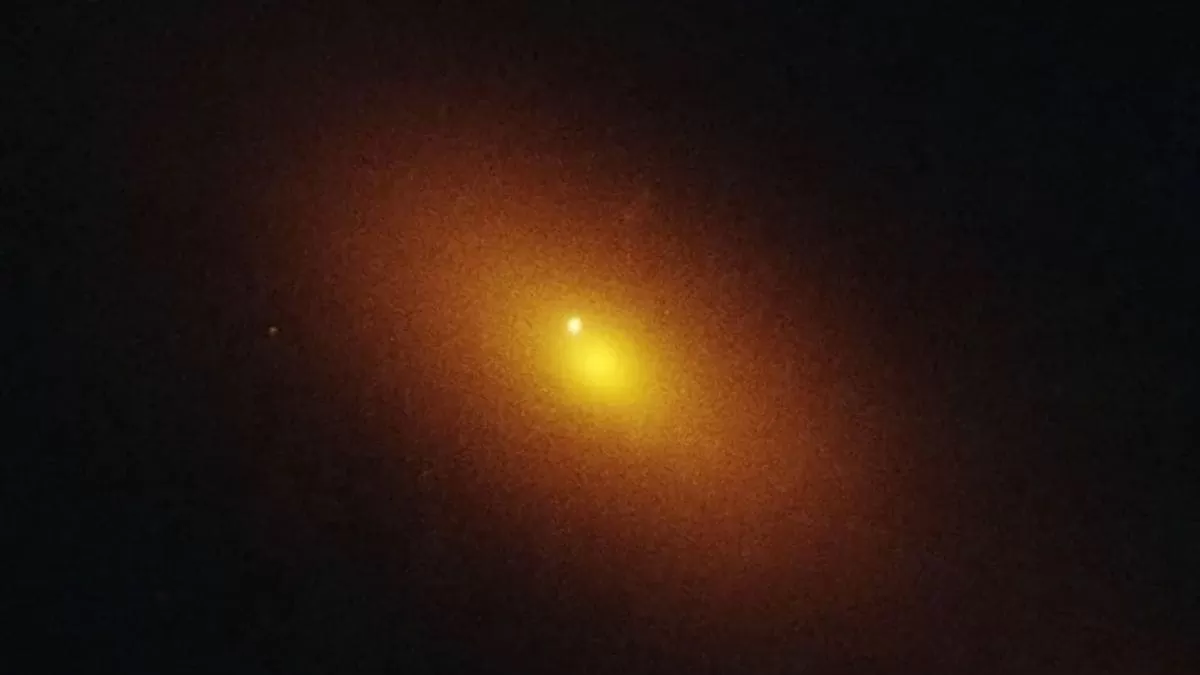
Astronomers have made an incredible discovery that has left the scientific community in awe. Led by Dr. Yuhan Yao, a team of astronomers has detected the first offset tidal disruption event (TDE) – a phenomenon where a rogue black hole outside a galaxy’s core devours a star. This groundbreaking discovery, made possible by the Hubble telescope and the Zwicky Transient Facility, provides historic evidence of a wandering supermassive black hole in action.
Tidal disruption events occur when a star gets too close to a black hole, and the intense gravitational pull from the black hole tears the star apart. This process releases an enormous amount of energy and produces a bright flare that can be observed by telescopes. However, in this case, the TDE was not happening in the center of a galaxy, as it usually does. Instead, it was occurring in a galaxy’s outskirts, indicating the presence of a wandering supermassive black hole.
Dr. Yao and his team were able to detect this rare event by analyzing data from the Hubble telescope and the Zwicky Transient Facility. The Hubble telescope captured the initial flare, and the Zwicky Transient Facility was able to track the event’s evolution over time. This collaboration between the two telescopes provided a more comprehensive understanding of the TDE.
The discovery of this offset TDE is a significant milestone in the field of astronomy. It confirms the existence of wandering supermassive black holes, which have long been theorized but never directly observed. These black holes are thought to have been ejected from their host galaxies due to gravitational interactions with other black holes or stars. This event provides crucial evidence to support this theory.
Furthermore, this discovery has opened up a whole new area of research for astronomers. By studying the properties of this wandering supermassive black hole, scientists can gain a better understanding of how these massive objects behave and evolve. It could also shed light on the dynamics of galaxies and their central black holes.
The team’s findings have been published in The Astrophysical Journal, and it has already garnered significant attention from the scientific community. Dr. Yao and his team are thrilled about the discovery and the impact it could have on our understanding of the universe.
This discovery also highlights the importance of collaboration and the use of advanced technology in astronomy. The Hubble telescope, which has been in operation for over 30 years, continues to provide groundbreaking discoveries. The Zwicky Transient Facility, a robotic sky survey, has also proven to be a valuable asset in detecting and tracking astronomical events.
The potential for more discoveries like this is immense, and it is a testament to the advancements in technology and the dedication of astronomers worldwide. With the help of these tools, we can continue to unravel the mysteries of the universe and expand our knowledge of the cosmos.
The discovery of the first offset TDE is a significant achievement for the scientific community and a testament to the power of human curiosity and ingenuity. It is a reminder that there is still so much to learn about the vast expanse of space and the wonders it holds. As Dr. Yao and his team continue to study this event, we can only imagine what other groundbreaking discoveries await us in the future.
In conclusion, the detection of the first offset TDE by Dr. Yao and his team is a historic moment in astronomy. It not only confirms the existence of wandering supermassive black holes but also opens up new avenues for research. With the help of advanced technology and collaboration, we can continue to push the boundaries of our knowledge and unravel the mysteries of the universe. This discovery is a testament to the endless possibilities of scientific exploration and a reminder that the universe is full of surprises waiting to be discovered.
