


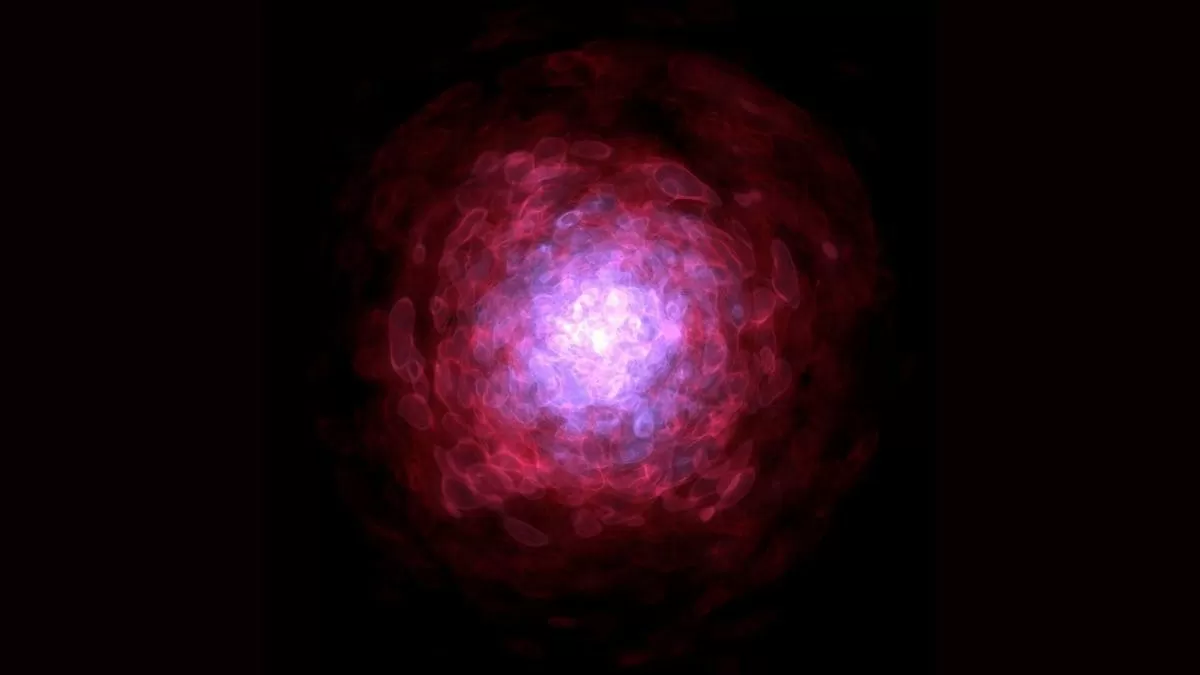
A groundbreaking study has recently been published, setting a new lower bound on the mass of ultralight bosonic dark matter particles. This groundbreaking discovery, made possible by the use of advanced computational models and data from the dwarf galaxy Leo II, has challenged the popular fuzzy dark matter theory and opened up new possibilities for exploring the mysteries of our universe.
The study, conducted by a team of researchers from various institutions, has set the lower limit for the mass of ultralight bosonic dark matter particles at 2.2 × 10⁻²¹ eV. This is a significant breakthrough in the field of dark matter research, as it provides a more accurate understanding of the nature and properties of this elusive substance.
Dark matter, as the name suggests, is a type of matter that does not interact with light or any other form of electromagnetic radiation. It is estimated that dark matter makes up about 85% of the total matter in the universe, yet its exact composition and properties remain a mystery. This is why scientists have been tirelessly working to unravel the secrets of dark matter, and this new study has brought us one step closer to that goal.
The team of researchers used data from the dwarf galaxy Leo II, which is located about 750,000 light-years away from Earth, to conduct their study. By analyzing the motion of stars within the galaxy, they were able to rule out lighter masses of dark matter that would not be able to form the observed structures. This has led to the establishment of the new lower bound on the mass of ultralight bosonic dark matter particles.
One of the most intriguing aspects of this study is that it challenges the popular fuzzy dark matter theory. This theory proposes that dark matter particles have a mass of about 10⁻²² eV, which is significantly lighter than the newly established lower bound. This means that the fuzzy dark matter theory may need to be revisited, and new theories and models may need to be developed to explain the nature of dark matter.
This groundbreaking discovery has far-reaching implications for our understanding of the universe. It not only sheds light on the mysterious nature of dark matter but also opens up new possibilities for exploring the vast expanse of our universe. With a more accurate understanding of the lower bound on the mass of ultralight bosonic dark matter particles, scientists can now focus their efforts on developing new experiments and technologies to detect and study this elusive substance.
The team’s use of advanced computational models has also been crucial in this study. These models have allowed scientists to simulate and analyze complex data, providing valuable insights into the properties of dark matter. With the continuous advancements in technology and computing power, we can expect even more groundbreaking discoveries in the field of dark matter research in the future.
This study has not only contributed to our understanding of dark matter but has also opened up new avenues for further research. Scientists can now explore the possibility of even lighter dark matter particles and their effects on the formation of structures in the universe. This could potentially lead to a better understanding of the evolution of our universe and its structures.
The team’s findings have been published in the prestigious journal Physical Review Letters, and it has already garnered significant attention from the scientific community. The study has been hailed as a major breakthrough in the field of dark matter research, and it has the potential to revolutionize our understanding of the universe.
In conclusion, the groundbreaking study that has set a new lower bound on the mass of ultralight bosonic dark matter particles has opened up new possibilities for exploring the mysteries of our universe. By challenging the popular fuzzy dark matter theory and using advanced computational models, the team has provided valuable insights into the properties of dark matter. This study is a significant step forward in our quest to unravel the secrets of the universe, and it paves the way for future discoveries and advancements in the field of dark matter research.
