


Central Asia is becoming an increasingly crucial region for the automotive industry, with both sales and production on the rise. In particular, Chinese brands are making a strong impact in this market, solidifying their position as major players in the global automotive industry.
The five countries that make up Central Asia – Kazakhstan, Kyrgyzstan, Tajikistan, Turkmenistan, and Uzbekistan – may not be the first places that come to mind when we think of the automotive industry. But recent developments in the region have put them on the map, attracting the attention of major car manufacturers from around the world.
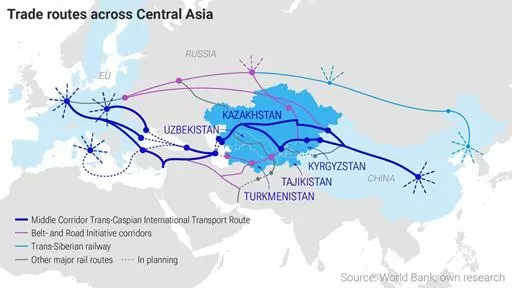
One of the main reasons for Central Asia’s growing importance in the automotive industry is its strategic location. These countries sit at the crossroads of Europe, Asia, and the Middle East, making them a prime location for trade and production. With their close proximity to some of the world’s largest automotive markets, such as China and India, Central Asian countries offer a lucrative opportunity for car manufacturers to expand their reach.
In recent years, the demand for automobiles has been steadily increasing in Central Asia, driven by a growing middle class and increasing purchasing power. According to a report by Research and Markets, the automotive market in Central Asia is expected to grow at a CAGR of 6.5% between 2020 and 2025, reaching a market value of USD 33.1 billion by 2025.
As the demand for cars in the region continues to rise, so does the need for local production. This allows car manufacturers to cater to the specific needs of the Central Asian market, such as offering more affordable options and models designed for rugged terrain. It also helps reduce import costs and creates job opportunities within the region.
Chinese car brands have been quick to recognize the potential of Central Asia and have taken advantage of the opportunity by establishing production facilities in the region. In Uzbekistan, one of the largest manufacturers of cars in Central Asia is the UzAuto Motors company, a joint venture between the Uzbekistan government and China’s SAIC Motor Corporation Ltd. The company produces a wide range of vehicles, including sedans, hatchbacks, and SUVs, and has recently announced plans to expand its production capacity to meet the growing demand in the region.
In neighboring Kazakhstan, the Chinese company SaryarkaAvtoProm is also making significant strides in the automotive industry. The company produces cars under the brands JAC Motors and Iveco, and its vehicles are gaining popularity among consumers in Central Asia for their affordability and quality.
But it’s not just Chinese car brands that are eyeing Central Asia as a production site. Other major global players, such as South Korea’s Hyundai and Japan’s Toyota, have also established production facilities in the region. This not only strengthens their presence in the local market but also helps create a healthy competition that benefits consumers.
Apart from production, Central Asia is also becoming a vital sales market for the automotive industry. The region’s growing middle class, along with favorable economic policies, has led to an increase in car ownership, especially in urban areas. As per the International Organization of Motor Vehicle Manufacturers, car sales in Central Asia recorded a 23.8% increase in 2019 compared to the previous year, with a total of 260,000 vehicles sold.
Recognizing the potential of the region, major car manufacturers have introduced special models and features tailored to the Central Asian market. For example, Hyundai’s new model for the region, the Solaris, offers air conditioning venting to the back seats – a feature that is particularly useful during the long, hot summers in Central Asia.
In addition to being a highly lucrative market for car sales and production, Central Asia also offers vast potential for electric vehicles. With the region’s ample renewable energy resources and a strong push towards sustainability, there is a growing demand for electric cars. China’s JAC Motors has already announced plans to introduce electric vehicles to the Central Asian market, and other companies are expected to follow suit.
In conclusion, Central Asia is undoubtedly gaining more and more importance for the automotive industry. With its strategic location, growing middle class, and increasing demand for cars, it presents a significant opportunity for global car manufacturers to expand their reach and tap into a new market. Chinese car brands, in particular, have made their mark in the region and are set to play a key role in the growth of the automotive industry in Central Asia. As this trend continues, we can expect to see more exciting developments
