

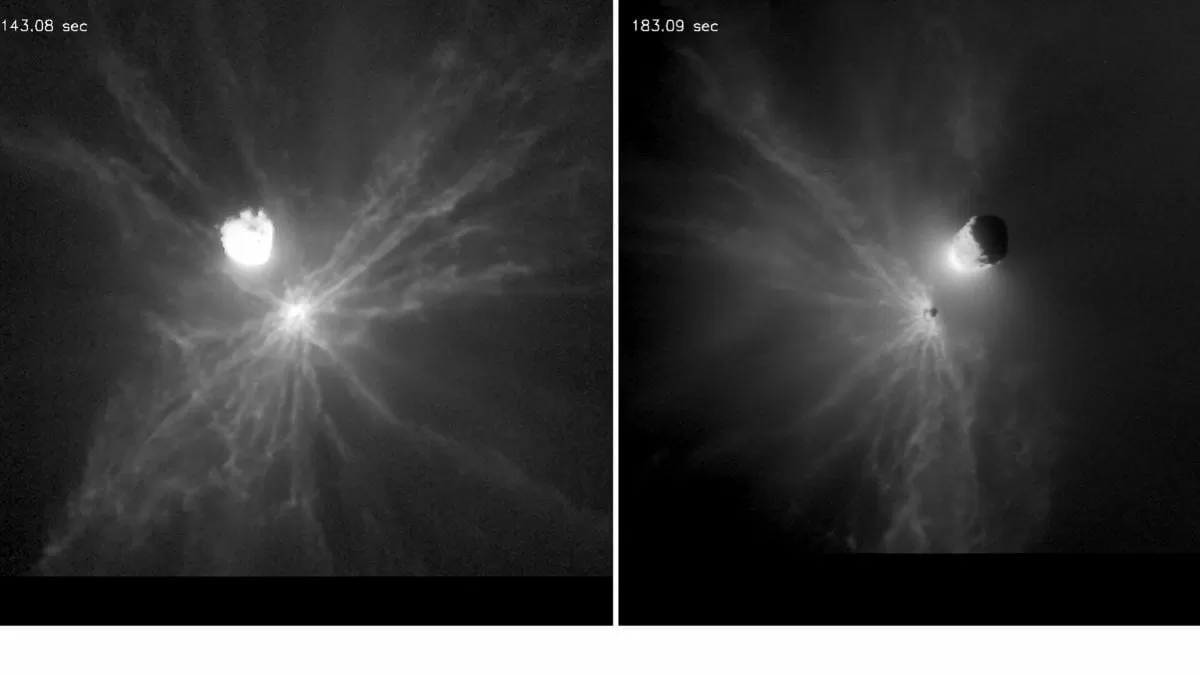
NASA’s DART mission has achieved a significant milestone in planetary defense by successfully deflecting an asteroid. However, this feat has not come without unexpected consequences. A recent study has revealed that the impact of DART has also unleashed high-velocity boulders, which may alter the asteroid’s spin and orbit. This discovery highlights the importance of considering all possible outcomes when planning future deflection strategies.
The DART (Double Asteroid Redirection Test) mission was launched by NASA in November 2021 with the goal of demonstrating the capability to deflect an asteroid on a collision course with Earth. The spacecraft, equipped with a kinetic impactor, was sent to collide with the asteroid Dimorphos, a small moon orbiting the asteroid Didymos. The impact was expected to change the moon’s orbit, providing valuable information for future asteroid deflection missions.
On September 26, 2022, DART successfully hit Dimorphos, altering its orbit by a small but measurable amount. This achievement was celebrated by the scientific community and marked a significant step towards protecting our planet from potential asteroid impacts. However, the DART mission also revealed some unexpected consequences that could complicate future deflection strategies.
A new study published in the journal Nature Astronomy has shown that DART’s impact on Dimorphos has unleashed high-velocity boulders with unexpected momentum. These chaotic ejecta, ranging in size from a few centimeters to several meters, were not accounted for in the initial planning of the mission. The study suggests that these boulders could significantly alter the asteroid’s spin and orbit, making it more challenging to predict its trajectory accurately.
The study’s lead author, Dr. Maria Antonietta Barucci, a planetary scientist at the Observatoire de Paris in France, explains, “The impact of DART has created a chaotic environment on the surface of Dimorphos, with boulders flying off in all directions. This could potentially affect the asteroid’s spin and orbit, making it more challenging to deflect in the future.”
The unexpected outcome of DART’s impact highlights the need to consider all possible scenarios when planning future asteroid deflection missions. The study’s co-author, Dr. Patrick Michel, a researcher at the French National Centre for Scientific Research, emphasizes the importance of this finding, stating, “Our study shows that we need to carefully consider all possible consequences of an impact before launching a deflection mission. It is crucial to understand the asteroid’s structure and composition to predict how it will respond to an impact.”
This discovery has also raised concerns about the safety of spacecraft sent to explore or deflect asteroids. The high-velocity boulders could pose a significant risk to spacecraft, making it challenging to get close enough to study or deflect an asteroid. This issue must be addressed before planning future asteroid missions.
Fortunately, ESA’s Hera mission, scheduled for launch in 2024, will provide valuable insights into the aftermath of DART’s impact on Dimorphos. Hera, named after the Greek goddess of marriage and fertility, will be the first spacecraft to visit a binary asteroid system. It will study the asteroid’s physical and chemical properties, including the impact crater created by DART, to better understand the effects of a kinetic impact on an asteroid.
Hera will also deploy two CubeSats, known as Juventas, to orbit Dimorphos and gather detailed information about its interior structure. This data will be crucial in developing more accurate models to predict the outcome of future asteroid impacts.
The Hera mission is a joint effort between ESA and NASA, with the latter providing the spacecraft’s communication system. This collaboration highlights the importance of international cooperation in planetary defense efforts. Dr. Andy Cheng, the Hera mission’s lead scientist at the Johns Hopkins Applied Physics Laboratory, expresses his excitement about the mission, stating, “Hera will provide us with a wealth of information about the asteroid’s properties and help us better understand the impact of DART on its surface.”
The unexpected consequences of DART’s impact on Dimorphos have highlighted the need to consider all possible outcomes when planning future asteroid deflection missions. The Hera mission will play a crucial role in further investigating the aftermath of DART’s impact and providing valuable data to inform future deflection strategies. This discovery serves as a reminder that our efforts to protect our planet from potential asteroid impacts are constantly evolving, and we must continue to adapt and improve our techniques to be successful.
