


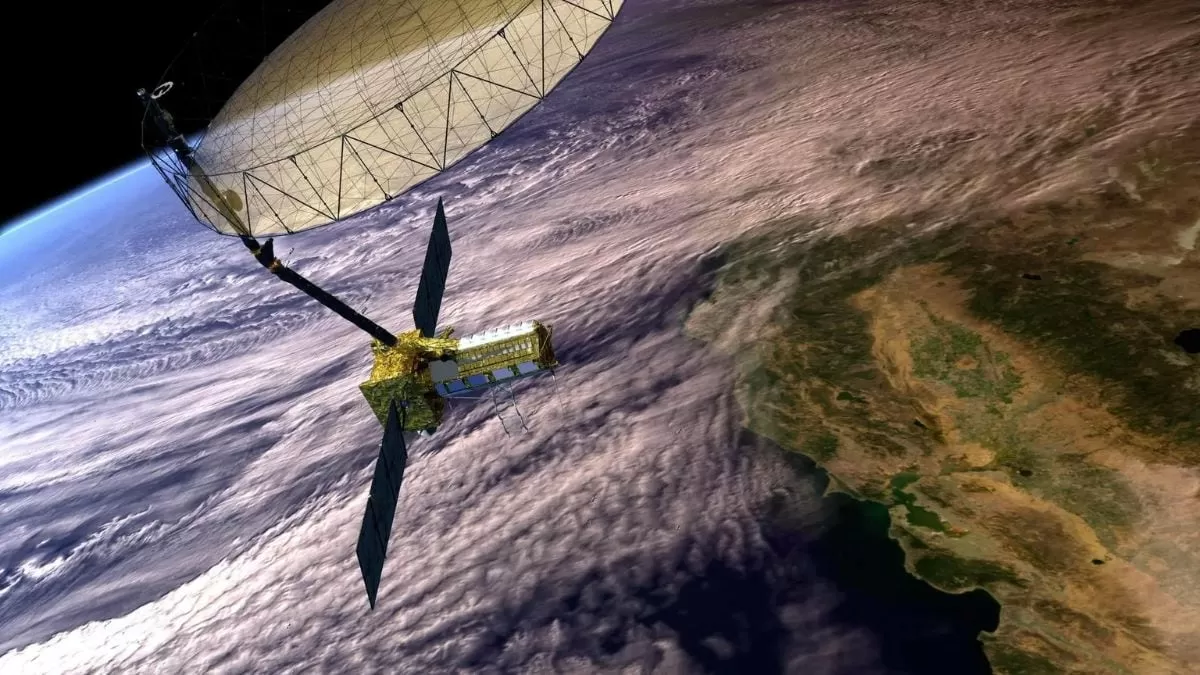
NASA and India’s ISRO (Indian Space Research Organization) are joining forces to launch the first-ever Earth-observing satellite equipped with advanced dual-band radar. This groundbreaking satellite, known as NISAR (NASA-ISRO Synthetic Aperture Radar), is set to lift off from Sriharikota, India in late July 2025. The collaboration between two of the world’s leading space agencies marks a significant milestone in space technology and promises to revolutionize our understanding of the Earth’s surface.
NISAR will be a game-changer in the field of Earth observation, providing accurate and detailed images of our planet like never before. With its dual-band radar system, NISAR will be able to map nearly all of Earth’s land and ice every 12 days, capturing even the slightest changes on the surface with an incredible precision of a few centimeters. This means that NISAR will be able to detect changes in land topography, ice sheets, and even vegetation cover with unprecedented accuracy.
The L-band radar, developed by NASA, will use longer wavelengths to penetrate the Earth’s surface and gather information on the planet’s land surface and vegetation. This will help scientists track changes in land use, monitor deforestation, and map areas prone to natural disasters such as floods and landslides. On the other hand, the S-band radar, developed by ISRO, will operate at shorter wavelengths and provide useful data on the Earth’s surface and subsurface conditions. This will be crucial in understanding the dynamics of ice sheets and predicting sea level rise due to climate change.
What sets NISAR apart from other Earth-observing satellites is its unique ability to combine both L-band and S-band radars, providing a comprehensive view of the Earth’s surface. This will enable scientists to study the Earth’s complex processes, such as interactions between land and ocean, and the impact of climate change on our planet. NISAR’s sophisticated radar system will not only capture images but also measure the speed and direction of surface movements, making it a crucial tool for disaster management and emergency response.
The launch of NISAR is the result of long-standing cooperation between NASA and ISRO. The two agencies have been working together since 2014 to develop and build this state-of-the-art satellite. The partnership has not only strengthened the ties between the two countries but has also opened up new avenues for collaboration in space technology. NISAR is a true testament to the power of international cooperation and the spirit of exploration that unites us all.
The satellite will be launched from the Satish Dhawan Space Centre in Sriharikota, India, using ISRO’s GSLV (Geosynchronous Satellite Launch Vehicle) MK II rocket. NISAR’s launch has been delayed several times due to technical challenges and the current COVID-19 pandemic. However, both NASA and ISRO are committed to ensuring a successful launch in late July 2025. The satellite will be placed in a polar orbit, providing global coverage of the Earth’s surface.
Once in orbit, NISAR will join the fleet of Earth-observing satellites already in operation, such as NASA’s Landsat and ESA’s Sentinel missions. However, NISAR’s advanced radar capabilities will take Earth observation to a whole new level. The data collected by NISAR will be freely available to scientists, researchers, and decision-makers around the world, helping us better understand our planet and make informed decisions for its protection.
The applications of NISAR’s data are endless, from monitoring changes in agriculture and water resources to studying the effects of climate change on vulnerable regions. The satellite will also provide valuable insights into the Earth’s geology, allowing scientists to study the planet’s past and present. NISAR will truly be a treasure trove of information for the scientific community and will pave the way for new discoveries and innovations in Earth science.
In addition to its scientific capabilities, NISAR will also have a positive impact on society. The satellite’s high-resolution images will aid in disaster response and management, helping to mitigate the impact of natural disasters and save lives. It will also support sustainable development by providing accurate data for urban planning, infrastructure development, and resource management. NISAR’s contributions to society will go beyond the realm of science and technology, making a meaningful difference in people’s lives.
In conclusion, the launch of NISAR in late July 2025 is an exciting development in space technology
