


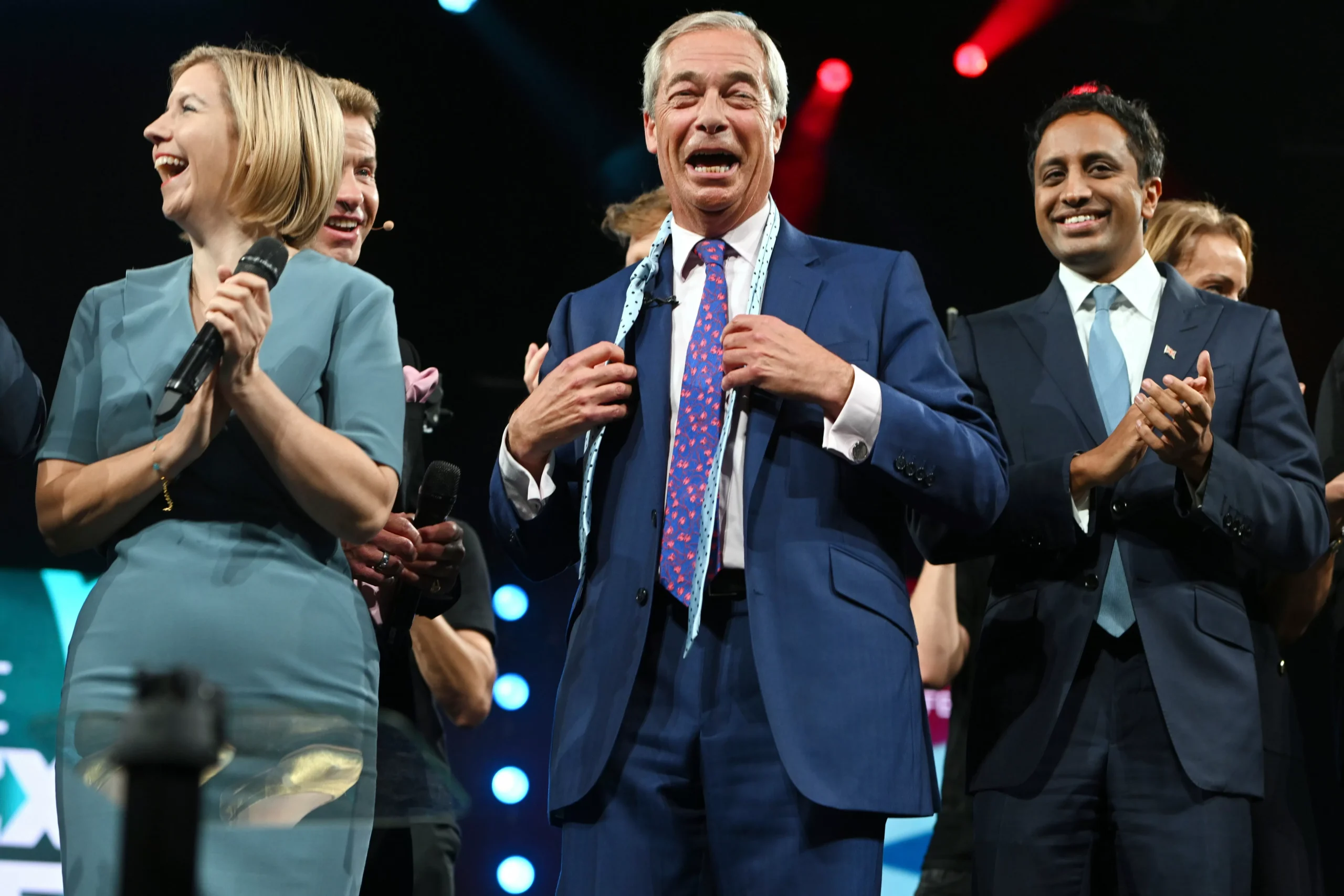
Britain’s Reform UK party leader Nigel Farage has been making waves in the political scene, and his recent comments and actions have caused quite a stir. At the party’s annual conference at the National Exhibition Centre in Birmingham, England, Farage was joined by Andrea Jenkyns and Zia Yusuf as he gave a passionate speech about the future of the country.
However, new analysis has revealed that a Reform UK majority at the next general election could have a significant impact on female representation in parliament. According to campaigners at 50:50 Parliament, if current opinion polls are accurate, women’s equality could fall for the first time in over 100 years.
Using Electoral Calculus polling data and a seat-level analysis, the campaigners found that female representation could drop from the current 41% to a mere 26% if Nigel Farage’s party continues to be the most popular party in British politics. This would be a significant setback for women’s rights and representation in the country.
Currently, Reform is polling at 27%, according to YouGov, while Labour trails behind at 18% and the Tories sit at 17%. This means that Farage’s right-wing party has comfortably held the lead for the last six months, and if this trend continues, it could have serious consequences for women in politics.
Non-partisan campaigners at 50:50 also pointed out that Reform’s 2024 candidate selection was just 16% women and 84% men – the worst ratio of all the parties, according to 50:50’s predictions. This is a concerning statistic, as it shows a lack of diversity and representation within the party itself.
Currently, Reform has five MPs, with only one of them being a woman – Sarah Pochin, who won the Runcorn and Helsby by-election in May. This lack of female representation within the party is also reflected in their most senior elected official, former Tory Andrea Jenkyns, who became the mayor of Greater Lincolnshire for Reform in the spring.
In an attempt to address this issue, the party held a “Women for Reform” press conference in August, where Pochin, Jenkyns, Westminster City councillor Laila Cunningham, and leader of Kent County Council Linden Kemkaran all declared that they were “proud to be one of Farage’s fillies”. However, this does not change the fact that the party’s policies and actions could have a detrimental effect on women’s representation in parliament.
On the other hand, if the Conservatives were to win a majority, 50:50 predicted that the proportion of women MPs would decrease to 33%, based on their 2024 candidate selection. Even if Labour, which had more female MPs win seats in 2024 than the whole of the Conservatives put together, were to win another majority, women’s representation would still remain below half at 47% in parliament.
A victory from the Greens would deliver 44% gender parity, while the Liberal Democrats would offer just 28%. These statistics show that there is still a long way to go in achieving gender equality in politics, and a Reform UK majority could set back the progress that has been made in recent years.
Lyanne Nicholl, CEO of 50:50, expressed her concerns about the potential impact of a Reform UK majority on women’s representation in parliament. “If these predictions play out, the impact on women’s representation will be devastating,” she said.
“This isn’t about party politics – it’s about democracy. More women MPs across all parties mean better policymaking that reflects women’s lived experiences. For decades, women MPs have driven landmark change – from Barbara Castle’s Equal Pay Act to Harriet Harman’s Equality Act, to Theresa May and Yvette Cooper’s cross-party reforms on domestic abuse. Without protecting these gains, we risk turning back the clock.”
Nicholl also emphasized the importance of having diverse voices and perspectives in parliament. “Whatever your views, without enough women at the table, we risk policymaking ignoring half of the population,” she said. “Diversity in leadership strengthens our economy, society, and democracy. This data is a wake-up call – we need everyone to act. Together we can stop parliament going backwards. Let’s build an equal parliament fit for the future.”
As part of their new ‘Ask Her To Stand’ campaign, 50:50 is installing a ‘push for equality’ panic button outside of parliament to raise awareness about
