


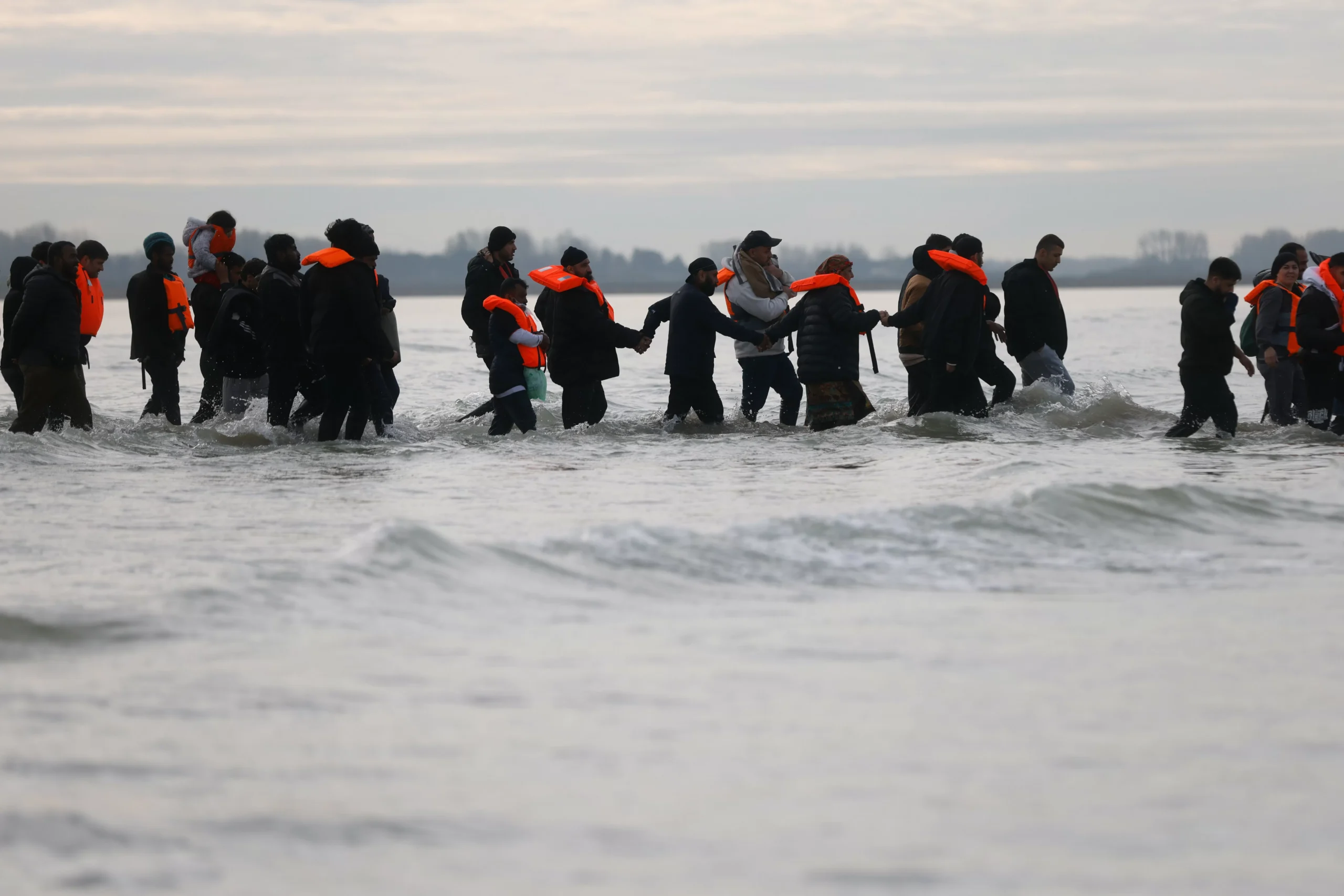
In recent years, the issue of irregular migration has become a major concern for governments all over the world. And in the UK, this issue has reached new heights in 2025, with the second highest number of small boat crossings on record. According to the Home Office, a staggering 41,472 people arrived in the UK by crossing the English Channel in small boats in 2025.
This is a concerning number, especially considering the promises made by Labour leader Keir Starmer to reduce irregular migration. The government’s efforts to curb this issue have been overshadowed by the rising numbers, with 2025 being second only to the record-breaking year of 2022, when 45,774 people arrived in the UK through this route.
The situation was on track to become even worse earlier this year, but thankfully, the rate of crossings slowed down during November and December, preventing 2025 from taking the top spot. However, this is still a cause for concern, as it shows that the government’s efforts have not been as effective as they had hoped.
Immigration has become a major sore spot for the government, with Prime Minister Boris Johnson promising to “smash the gangs” responsible for bringing migrants into the country during the 2024 general election. He also negotiated a “one-in, one-out” deal with France last year in an attempt to discourage further crossings. However, these efforts have not had the desired impact, and the rising numbers have become a gift to his political opponents.
Tory Shadow Home Secretary Chris Philp has called for the UK to leave the European Convention on Human Rights (ECHR), stating that “there is no deterrent” at the moment and that “Labour lack the backbone to confront that truth.” This call for more extreme measures has been echoed by Reform UK leader Nigel Farage, who has labeled Starmer’s efforts as a “complete disaster” and has warned that “many of the young men who arrived last year will do us great harm.”
Meanwhile, the chief executive of the Refugee Council, Enver Solomon, has shed light on the reasons behind these dangerous journeys. He stated that most of the men, women, and children making these crossings have fled oppressive regimes, such as the Taliban in Afghanistan, and brutal civil wars in countries like Sudan. These individuals are risking their lives in flimsy boats in the Channel out of desperation to be safe in a country where they have family or community connections.
It is important to acknowledge the desperation and dire circumstances that drive these individuals to take such risks. While it is understandable that the government wants to stop these dangerous crossings, plans that will punish people found to be refugees are unfair and not an effective deterrent. As Enver Solomon rightly points out, “no one risks their life on a flimsy boat in the Channel except out of desperation to be safe.”
The rising numbers have been described as “shameful” by a Home Office spokesperson, who also added that British people “deserve better.” And we couldn’t agree more. The safety and security of British citizens should always be a top priority for the government.
But the good news is that the government is taking action. Almost 50,000 people who were in the UK illegally have been removed, and the historic deal with France means that those who arrive in small boats are now being sent back. Additionally, Home Secretary Shabana Mahmood recently unveiled the Border Security, Asylum, and Immigration Act, which aims to “rapidly disrupt the people-smuggling gangs.”
This is a step in the right direction, and it is heartening to see the government taking a proactive approach to tackle this issue. These reforms will not only help to reduce irregular migration but also ensure the safety and security of British citizens.
In conclusion, the high number of small boat crossings in 2025 is a cause for concern, but it is also an opportunity for the government to show its commitment to protecting its citizens and addressing the root causes of irregular migration. It is time to work together and find long-term solutions that are fair, just, and compassionate towards those who are fleeing desperate situations. As a nation, we must not forget our values of compassion and humanity, and instead, come together to find solutions that work for everyone.
