


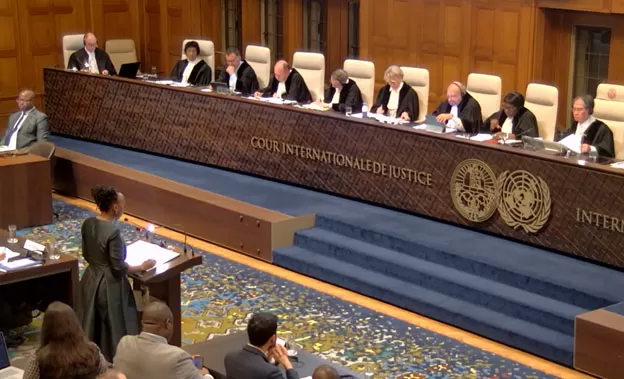
On January 12, the International Court of Justice (ICJ) opened a historic case that has been years in the making. The Republic of The Gambia has brought forth allegations against Myanmar’s military, accusing them of committing acts of brutal genocide against the Rohingya minority during their 2017 crackdown. This case has been described by the United Nations (UN) as a crucial step towards justice for the Rohingya people.
The Rohingya are a Muslim minority group in Myanmar, a predominantly Buddhist country. They have faced discrimination and persecution for decades, but the situation escalated in 2017 when the military launched a brutal crackdown in response to attacks by Rohingya militants. The UN estimates that over 700,000 Rohingya fled to neighboring Bangladesh, while thousands were killed and countless others were subjected to horrific acts of violence, including rape and torture.
The Gambia, a small West African nation, has taken a bold step in bringing this case to the ICJ. The country’s attorney general and justice minister, Abubacarr Tambadou, has been a vocal advocate for the Rohingya people and has been working tirelessly to hold Myanmar accountable for their actions. In a statement, Tambadou said, “The Gambia took this action to send a clear message to Myanmar and to the rest of the international community that the world must not stand by and do nothing in the face of such blatant and ongoing violations of international law.”
The ICJ is the principal judicial organ of the United Nations and is responsible for settling legal disputes between member states. This is the first time that the court will hear a case involving allegations of genocide. The hearings, which are expected to last for several days, will include testimonies from Rohingya refugees, expert witnesses, and representatives from both Myanmar and The Gambia.
The Gambia’s case is based on the 1948 Genocide Convention, which defines genocide as “acts committed with intent to destroy, in whole or in part, a national, ethnical, racial or religious group.” The country’s legal team will argue that Myanmar’s military carried out a systematic campaign of violence against the Rohingya with the intent to destroy the group. They will also present evidence of mass killings, rape, and destruction of Rohingya villages as proof of genocide.
Myanmar, on the other hand, has denied the allegations and maintains that their military was responding to terrorist attacks by Rohingya militants. The country’s leader, Aung San Suu Kyi, who was awarded the Nobel Peace Prize for her fight against military rule, will personally lead the defense team at the ICJ. This has sparked criticism and disappointment from the international community, who expected her to use her influence to address the Rohingya crisis.
The outcome of this case will have significant implications for the Rohingya people and for the international community as a whole. If the ICJ rules in favor of The Gambia, it could lead to further investigations and potential sanctions against Myanmar. It would also send a strong message that the international community will not tolerate genocide and will hold those responsible accountable for their actions.
The hearings at the ICJ have already brought renewed attention to the plight of the Rohingya people and have sparked hope for justice among the survivors and their families. It is a crucial step towards acknowledging the atrocities committed against the Rohingya and ensuring that they are not forgotten.
As the world watches and waits for the ICJ’s decision, it is important to remember that this case is not just about two countries. It is about standing up for human rights, justice, and the protection of vulnerable communities. It is about sending a message that genocide will not be tolerated, and those responsible will be held accountable. Let us hope that the ICJ will deliver a fair and just ruling, and that it will mark the beginning of a new chapter for the Rohingya people.
