


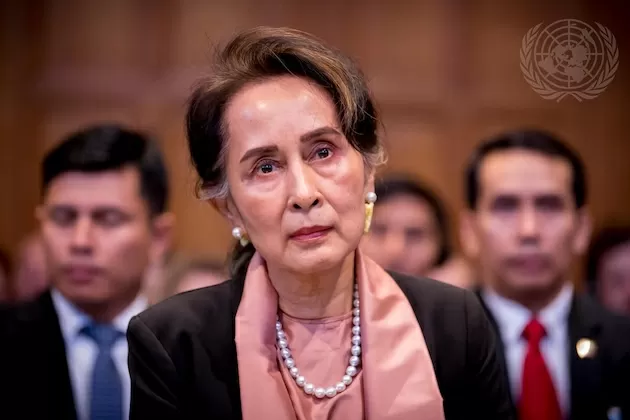
Held incommunicado in grim prison conditions for nearly five years, Nobel Peace Prize laureate Aung San Suu Kyi may not even be aware of the groundbreaking case against her country, Myanmar, at the International Court of Justice (ICJ). This week, the ICJ opened a landmark case charging Myanmar with committing genocide against its Rohingya minority nearly a decade ago. For a woman who has dedicated her life to promoting peace and democracy in her country, it is a tragic irony that she is now facing accusations of being complicit in acts of genocide.
Aung San Suu Kyi, affectionately known as “The Lady” by her supporters, has been held under house arrest for 15 out of the past 21 years due to her unwavering stand against the oppressive military regime in Myanmar. Despite facing constant persecution and personal sacrifices, she has remained steadfast in her commitment to democracy, non-violent resistance and reconciliation among different ethnic groups in her country.
However, her global reputation as a human rights champion has been severely challenged since the outbreak of violence against the Rohingya in 2017. As the de facto leader of Myanmar, she has been heavily criticized for her silence and inaction towards the atrocities committed by the military against the minority group. The United Nations has described the violence as a “textbook case of ethnic cleansing” and has accused the Myanmar military of committing acts of genocide against the Rohingya.
The ICJ’s decision to open a case against Myanmar is a significant step towards justice for the hundreds of thousands of Rohingya who have been displaced, killed and raped in what has been described as a systematic campaign of ethnic cleansing. The court has also ordered Myanmar to take immediate measures to prevent further acts of violence against the Rohingya community.
This landmark case at the ICJ has brought renewed focus on Aung San Suu Kyi and her role in the ongoing crisis in Myanmar. The de facto leader has been criticized for her refusal to acknowledge the allegations of genocide against the Rohingya and for defending the actions of the military. She has also faced widespread condemnation for her denial of the existence of the Rohingya as an ethnic group and for her failure to take concrete steps towards resolving the crisis.
For a woman who has been hailed as a symbol of democracy and human rights, Aung San Suu Kyi’s apparent lack of concern for the rights of the Rohingya has been met with disappointment and anger from the international community. Her inaction and silence on the issue have also led to the revocation of some of her prestigious honors, including the honorary Canadian citizenship and the Freedom of the City of Oxford.
Many have questioned whether Aung San Suu Kyi, who herself has experienced the oppression and injustice of a military regime, has abandoned her principles in the face of political expediency. Some argue that she is a prisoner of her own political ambitions and is willing to sacrifice her moral values for the sake of maintaining power.
However, Aung San Suu Kyi’s supporters argue that she is in a difficult position, caught between the expectations of the international community and the powerful military in her own country. They believe that she is using her position as a leader to bring about gradual democratic reforms and that healing the deep-seated ethnic divisions in Myanmar is a complex and delicate process.
Despite the controversy surrounding her role in the Rohingya crisis, Aung San Suu Kyi remains a powerful and influential figure in Myanmar. Her party, the National League for Democracy, won a landslide victory in the 2015 elections, signaling a new era of hope and change for the country. Her leadership has also been credited with bringing about significant economic progress and political reforms in Myanmar.
As the ICJ continues its proceedings against Myanmar, the spotlight will remain on Aung San Suu Kyi and her response to the allegations of genocide. Some hope that the case will bring about a sense of accountability and justice for the victims of the violence, while others fear that it may further polarize the country and undermine the fragile democratic progress.
In such a complex and challenging situation, it is important to remember that Aung San Suu Kyi is a human being, with her own struggles and limitations. While her actions and statements may be subject to scrutiny and criticism, we must not forget the decades of sacrifices she has made for the betterment of her country. Let us hope that this case will serve as a catalyst for reconciliation and healing in Myanmar, and that Aung San Suu Kyi will
