


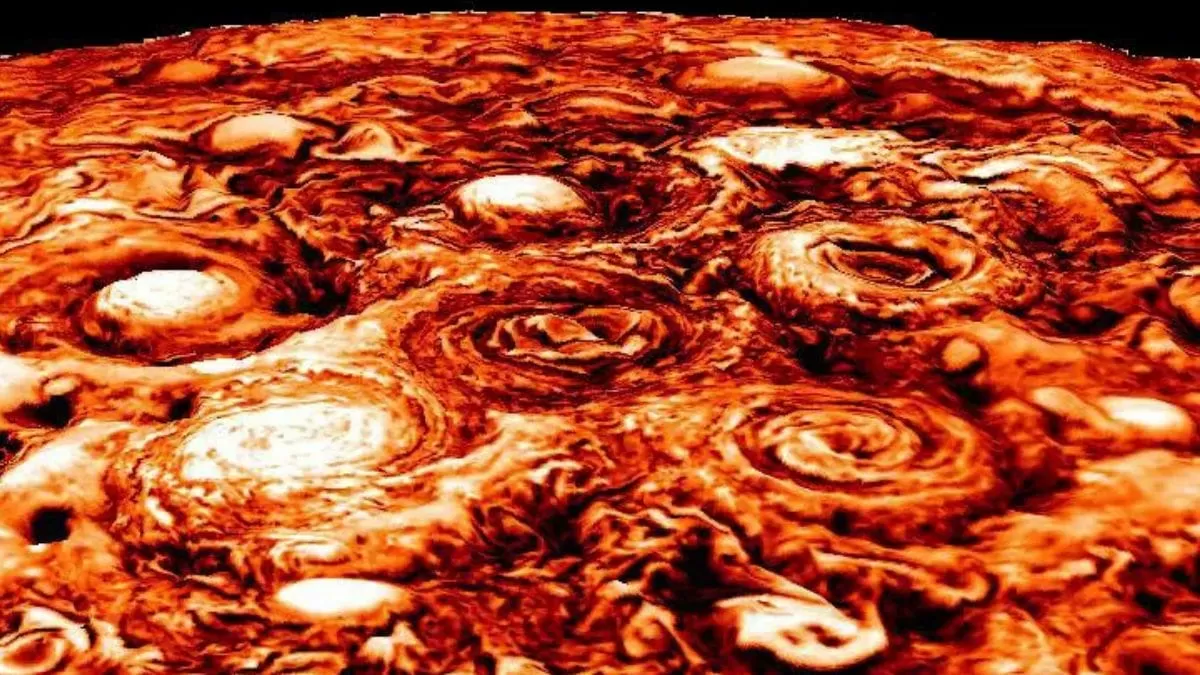
NASA’s Juno probe has been making groundbreaking discoveries since its arrival at Jupiter in 2016. Recently, the spacecraft has revealed new and fascinating insights into the gas giant’s extreme weather and volcanic activity. Using thermal and microwave instruments, scientists have observed colliding cyclones at Jupiter’s north pole and flowing magma beneath the surface of its volcanic moon, Io.
The findings, published in two separate studies in the journal Nature, have completely reshaped our understanding of the Jovian system. These discoveries not only highlight the incredible capabilities of the Juno spacecraft but also offer a glimpse into the chaotic and dynamic nature of Jupiter and its moons.
One of the most striking discoveries is the presence of colliding cyclones at Jupiter’s north pole. These massive storms, each about the size of Earth, have been observed to merge and form a single, larger storm. This phenomenon, known as “cyclone merger”, has never been seen before in our solar system. The Juno spacecraft, with its advanced thermal and microwave instruments, was able to capture this rare event and provide scientists with a better understanding of the gas giant’s atmospheric dynamics.
The images captured by Juno also revealed a chaotic and turbulent atmosphere, with swirling clouds and storms of different sizes and shapes. This is in stark contrast to the relatively calm and predictable weather patterns observed on Earth. Scientists believe that the extreme weather on Jupiter is a result of its fast rotation, which creates powerful jet streams and vortices in its atmosphere.
In addition to the atmospheric chaos, Juno’s instruments also detected a subsurface ocean of molten magma on Io, one of Jupiter’s four largest moons. This discovery was made possible by measuring the moon’s thermal emission, which revealed the presence of intense volcanic activity beneath its surface. Io is the most volcanically active object in our solar system, with over 400 active volcanoes. The data collected by Juno has provided scientists with a better understanding of the moon’s internal structure and the processes that drive its volcanic activity.
These discoveries have also shed light on the relationship between Jupiter and its moons. It is believed that the gas giant’s strong gravitational pull is responsible for the intense volcanic activity on Io. The tidal forces created by Jupiter’s gravity cause the moon’s interior to heat up, resulting in the constant eruption of lava from its surface.
The new findings from Juno’s mission have not only expanded our knowledge of the Jovian system but also opened up new avenues for future research. Scientists are now eager to study the colliding cyclones and the subsurface magma ocean in more detail, using the wealth of data collected by the spacecraft.
The success of the Juno mission is a testament to the incredible advancements in space technology and the determination of the team behind it. Launched in 2011, the spacecraft has traveled over 1.8 billion miles to reach Jupiter and has been orbiting the gas giant for over four years. Its mission is to study Jupiter’s atmosphere, magnetic field, and gravitational field, providing us with a better understanding of the planet’s formation and evolution.
The discoveries made by Juno have not only reshaped our understanding of Jupiter and its moons but also motivated scientists to continue exploring the mysteries of our solar system. With the help of advanced technology and dedicated researchers, we can expect to uncover even more secrets of these distant worlds in the future.
In conclusion, NASA’s Juno probe has once again proven to be a valuable asset in unraveling the mysteries of our solar system. Its latest discoveries of colliding cyclones and subsurface lava flows on Jupiter and its moon Io have provided us with a deeper understanding of the extreme weather and volcanic activity in the Jovian system. These findings have not only expanded our knowledge but also sparked a sense of wonder and curiosity about the vast and complex universe we live in.
