


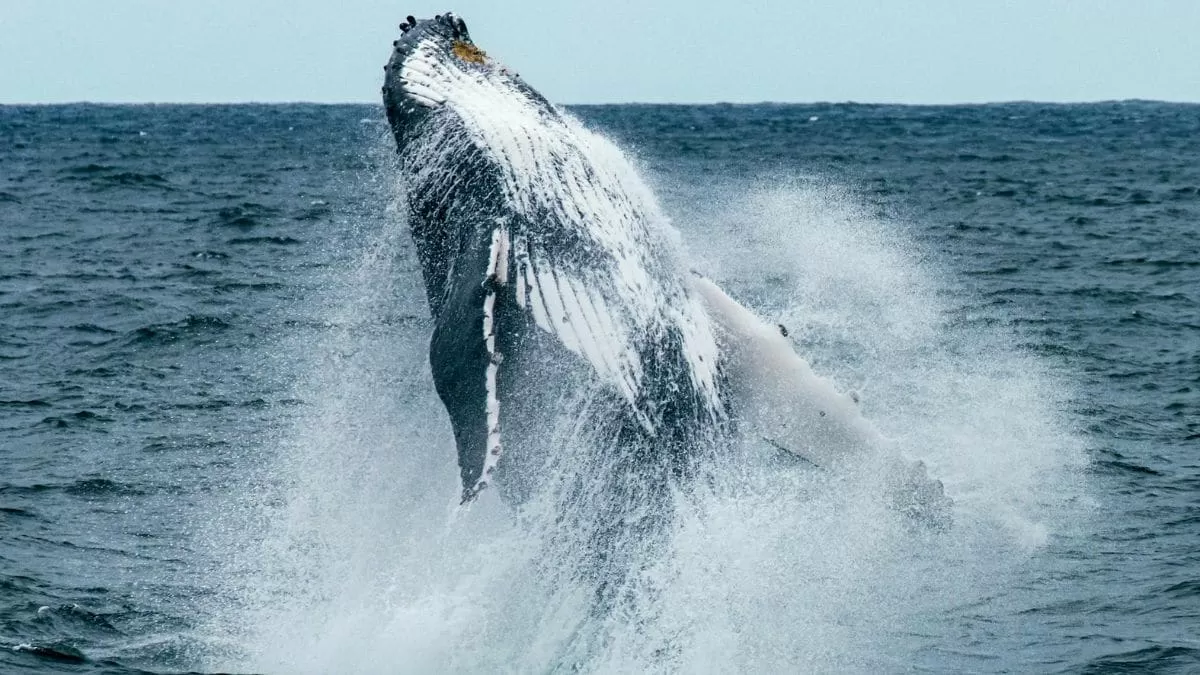
North Atlantic Right Whales are one of the most magnificent creatures on this planet, but sadly, they are also one of the most endangered. These gentle giants, who can grow up to 50 feet long and weigh up to 70 tons, have been facing numerous threats to their survival. From fishing gear entanglement to ship collisions, the North Atlantic Right Whales have had to overcome various challenges to survive in their natural habitat.
But there is hope for these majestic creatures, as scientists are now using NASA satellite data to track their key food source in the Gulf of Maine. This food source is the red-colored plankton Calanus finmarchicus, a type of copepod that is crucial for the survival of North Atlantic Right Whales.
The North Atlantic Right Whales are filter feeders, which means they rely on plankton as their main source of food. These whales can consume up to 2,500 pounds of plankton per day, making it essential for them to have a constant and reliable supply of this food source.
However, the population of Calanus finmarchicus has been declining in recent years, and this has had a direct impact on the North Atlantic Right Whales. With fewer plankton available, the whales have had to travel further and spend more time searching for food, which makes them more vulnerable to other threats such as ship strikes and entanglement in fishing gear.
To address this issue, scientists have turned to NASA satellite data to track the movements of this crucial plankton. The satellite data allows them to identify and map the swarms of Calanus finmarchicus, as its natural red pigment makes it easier to spot in the vast ocean.
By tracking the movements of this plankton, scientists can now predict where the North Atlantic Right Whales are likely to be found, and this information can be used to implement protective measures to ensure their safety. For example, shipping lanes can be adjusted to avoid areas where the whales are feeding, and fishing gear can be modified to reduce the risk of entanglement.
The use of NASA satellite data has revolutionized the way scientists study and protect the North Atlantic Right Whales. In the past, researchers had to rely on traditional methods such as aerial surveys, which were not as accurate and could only cover a limited area. With satellite data, scientists now have a more comprehensive and real-time view of the ocean, allowing them to make more informed decisions to protect these endangered whales.
The success of this approach was demonstrated in a recent study where scientists used satellite data to track the movements of North Atlantic Right Whales in the Gulf of Maine. The researchers were able to predict the whales’ movements with an accuracy of up to 86%, which is a significant improvement compared to previous methods.
The use of NASA satellite data not only benefits the North Atlantic Right Whales but also the entire ecosystem of the Gulf of Maine. As the whales feed on Calanus finmarchicus, they also help to maintain a healthy balance in the ocean by controlling the population of this plankton. Without the whales, there could be an overabundance of this plankton, which could have a negative impact on other marine species.
This groundbreaking research highlights the importance of collaboration between different fields of study. By combining the expertise of scientists and the technology of NASA, we can make a significant difference in protecting our planet’s endangered species.
However, this is just the beginning, and there is still a long way to go in ensuring the survival of the North Atlantic Right Whales. It is crucial that we continue to monitor and track their movements and take necessary measures to protect their habitat.
We also need to address other threats that the North Atlantic Right Whales face, such as climate change, ocean pollution, and noise pollution. These factors can have a significant impact on the whales’ food supply and their ability to communicate, navigate, and find potential mates.
It is our responsibility to protect and preserve the North Atlantic Right Whales for future generations. These magnificent creatures have been a part of our planet for millions of years, and it is our duty to ensure that they continue to thrive in their natural habitat.
The use of NASA satellite data to track the key food source of the North Atlantic Right Whales is a significant step towards their conservation. It gives us hope that with continued efforts and advancements in technology, we can protect these endangered mammals and help them thrive once again in the vast ocean.
