


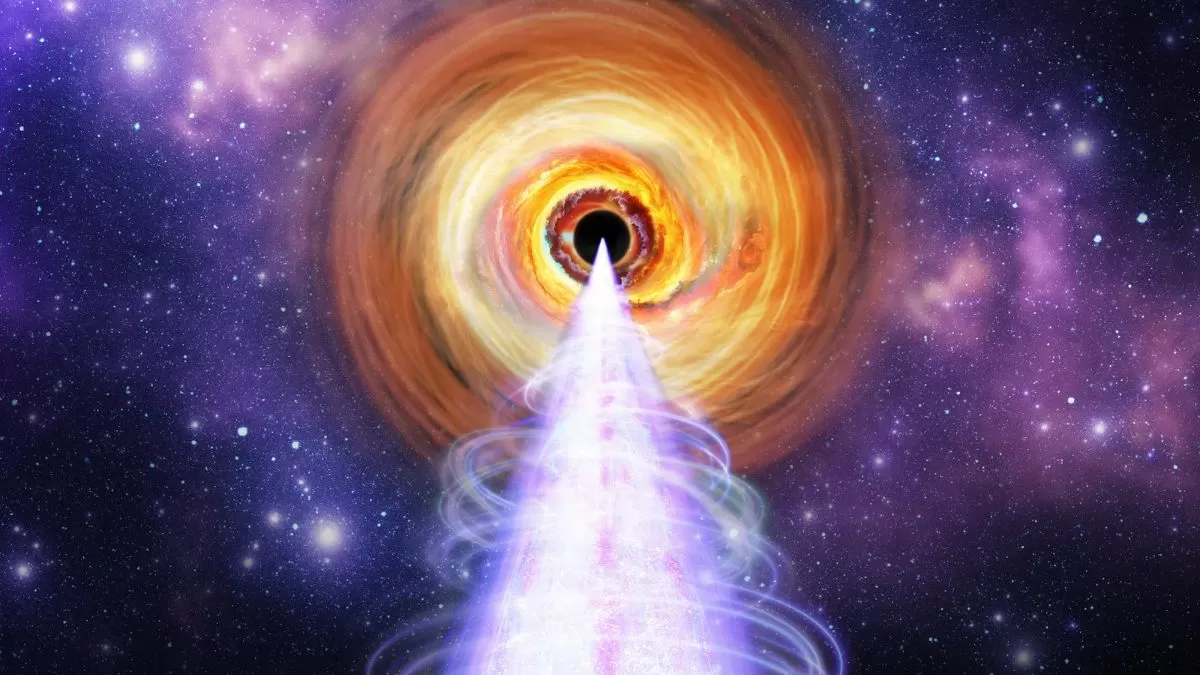
NASA’s IXPE satellite has recently made a groundbreaking discovery that could potentially unlock the mysteries surrounding X-rays produced in the extreme jets of supermassive black holes. By observing the blazar BL Lacertae, IXPE has recorded low X-ray polarization versus very high optical polarization, providing evidence for Compton scattering as the main mechanism responsible for the production of X-rays in these powerful jets.
This breakthrough has been hailed as a major achievement for astrophysics, as it provides a crucial puzzle piece in understanding the behavior of black holes and their effect on the surrounding environment. Blazars, or active galactic nuclei, are among the most energetic and distant objects in the universe, powered by supermassive black holes at their centers. These black holes have been known to emit powerful jets of particles and radiation, but the exact mechanism behind the production of X-rays in these jets has long puzzled scientists.
The IXPE (Imaging X-ray Polarimetry Explorer) satellite is a joint mission between NASA and the Italian Space Agency, designed to study the polarization of cosmic X-rays. This is the first satellite to be solely dedicated to measuring the polarization of X-rays, which is a crucial tool in understanding the physical processes that occur in extreme environments such as black holes. Launched in 2021, IXPE carries three telescopes that are specifically designed to measure X-ray polarization.
By observing BL Lacertae, a blazar located 900 million light years away, IXPE was able to measure the polarization of X-rays and compare it to the polarization of optical light. The results were astounding – while the optical light showed very high polarization, the X-rays were found to have low polarization. This stark difference in polarization between these two types of radiation confirmed Compton scattering as the main mechanism responsible for the production of X-rays in the jets of supermassive black holes.
Compton scattering is a phenomenon in which high-energy photons interact with high-speed electrons, resulting in a change in the direction and energy of the photons. This process is believed to occur in the jets of supermassive black holes, where electrons are accelerated to near-light speed and collide with photons, producing X-rays. This new evidence from IXPE not only provides a solution to the long-standing mystery of X-ray production in black hole jets, but also supports the electron-photon interaction theory of Compton scattering.
The implications of this discovery are immense. Understanding the physical processes that occur in black hole jets is crucial in unraveling the mysteries of the universe. These powerful jets have a profound impact on their surrounding environment, and their study can shed light on the formation and evolution of galaxies. This breakthrough from IXPE opens up new avenues for research in the field of astrophysics and could potentially lead to further advancements in our understanding of the universe.
Moreover, the success of IXPE also highlights the importance of international collaborations in the field of space exploration. The joint efforts of NASA and the Italian Space Agency have resulted in a groundbreaking discovery that could have not been achieved by either agency alone. This also serves as a reminder of the crucial role that space missions play in advancing our knowledge of the universe and the need for continued support and funding for such endeavors.
The IXPE satellite is expected to continue its observations of blazars and other high-energy objects, providing valuable data that will further our understanding of the physical processes that occur in these extreme environments. With the confirmation of Compton scattering as the main mechanism behind X-ray production in black hole jets, scientists can now focus on studying the details of this process and its impact on the surrounding environment.
In conclusion, NASA’s IXPE satellite has made a significant contribution to astrophysics with its recent discovery. By observing the blazar BL Lacertae, IXPE has provided evidence for Compton scattering as the main mechanism for the production of X-rays in the jets of supermassive black holes. This breakthrough has opened up new avenues for research and has the potential to further our understanding of the universe. With the success of IXPE, the future of space exploration and astrophysics looks brighter than ever before.
