
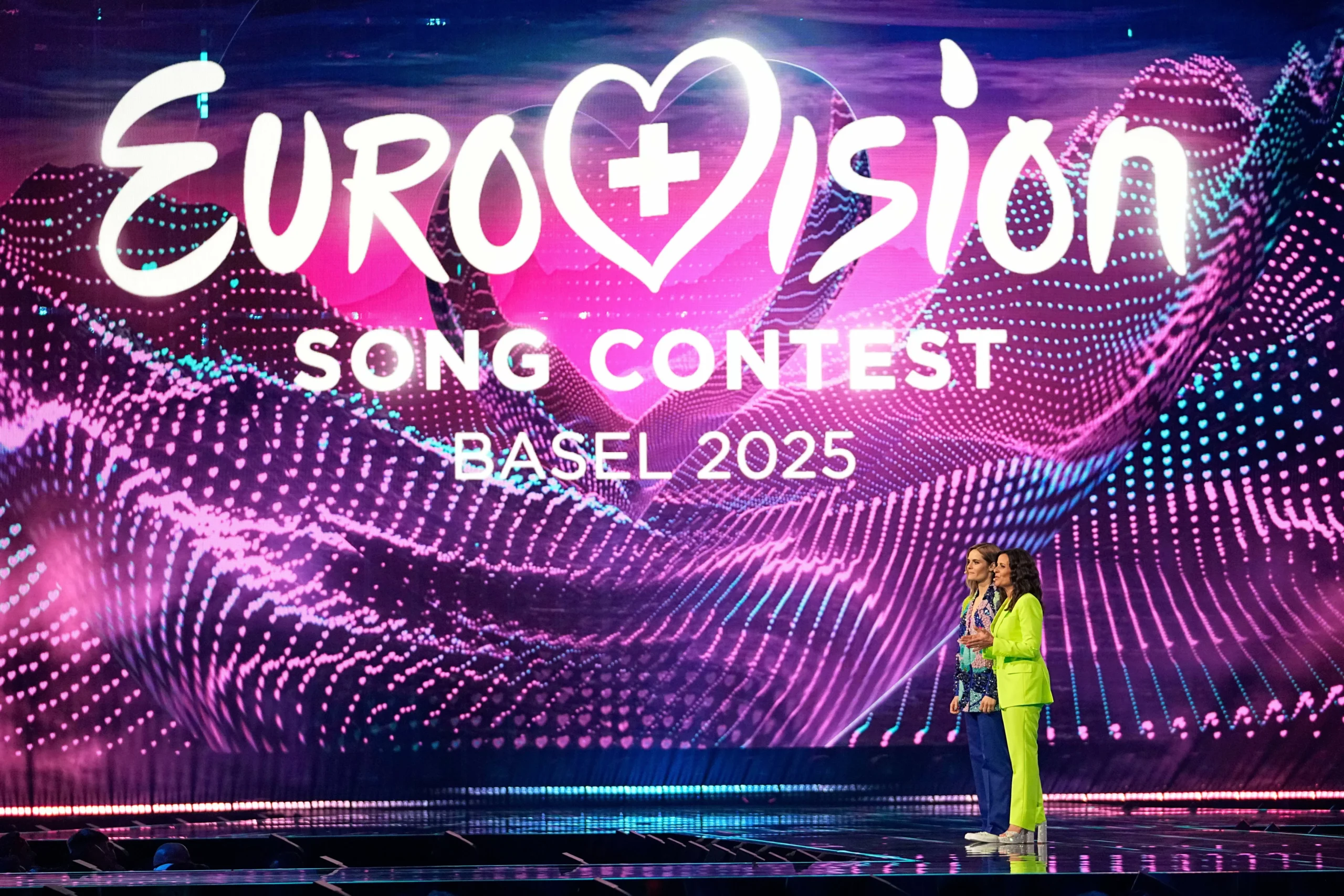
This year’s Eurovision Song Contest in Basel, Switzerland was filled with excitement, controversy, and a powerful message. As the world watched the semi-finals, all eyes were on the hosts of the show, Hazel Brugger and Sandra Studer, who captured the audience’s attention with their charming wit and charisma. However, it was not just their hosting skills that made headlines. A political message displayed by Spain’s national broadcaster before the live broadcast caused quite a stir.
Prior to the start of the competition, RTVE, Spain’s national broadcaster, aired a black and white message in both Spanish and English that read, “When human rights are at stake, silence is not an option. Peace and Justice for Palestine.” This powerful message caught the attention of many, sparking a debate over whether political statements have a place in the Eurovision Song Contest.
The European Broadcasting Union (EBU), the governing body of Eurovision, confirmed that they had spoken to RTVE regarding the message and reminded them of the rules around neutrality. Eurovision has strict guidelines against political messaging, and any violation could result in a fine. However, the EBU declined to comment on the matter, stating that they had addressed it with RTVE.
This was not the first time that Eurovision has been embroiled in controversy leading up to the competition. Israel’s participation in the contest, amidst the ongoing conflict in Gaza, was a hot topic of discussion. Slovenia and Spain were the first two countries to raise concerns about Israel’s involvement, followed by Iceland and Ireland. The EBU had previously stated that they would discuss Israel’s participation with its member broadcasters after this year’s event.
These concerns were not limited to just the broadcasters. More than 70 musicians and performers associated with Eurovision, including multiple former winners, signed an open letter urging producers to remove Israel from the competition, similar to how Russia was banned in 2022 due to the invasion of Ukraine. The reigning champion, Nemo, also spoke out against Israel’s participation, stating that their actions are not in line with the values Eurovision claims to uphold.
Despite the controversy, Israel’s representative Yuval Raphael gave a stunning performance and ended up finishing in second place behind Austria’s JJ. This year’s Eurovision was a historic moment for Israel, as it was their first time placing in the top three. Yuval also received the highest number of points from televoters, proving that the audience was captivated by his performance.
As the dust settles on this year’s Eurovision, it is important to reflect on the bigger picture. Eurovision is a celebration of diversity, unity, and music. It brings together countries from all over Europe and beyond, showcasing their unique cultures and talents. It is a platform for artists to share their voices and connect with a global audience.
In this spirit, Eurovision should not be used as a platform for political agendas. While it is important to stand up for human rights and justice, it is also crucial to respect the rules and spirit of the competition. The EBU and its member broadcasters have a responsibility to maintain the neutrality of Eurovision and ensure that it remains a celebration of music and unity.
As we look back on this year’s Eurovision, we cannot ignore the impact of the political message displayed by RTVE. It sparked important conversations and highlighted the power of music to bring attention to important issues. However, it is crucial to remember that Eurovision is first and foremost a music competition, and we should celebrate the talents and performances of all the artists who took part.
In the end, Eurovision is a celebration of diversity, unity, and the love for music. Let us continue to come together through music and celebrate the beauty of our differences. Congratulations to all the artists who participated in this year’s Eurovision Song Contest, and a special congratulations to Israel’s Yuval Raphael for his exceptional performance. We cannot wait to see what the future holds for Eurovision and the talented artists who grace its stage.
