


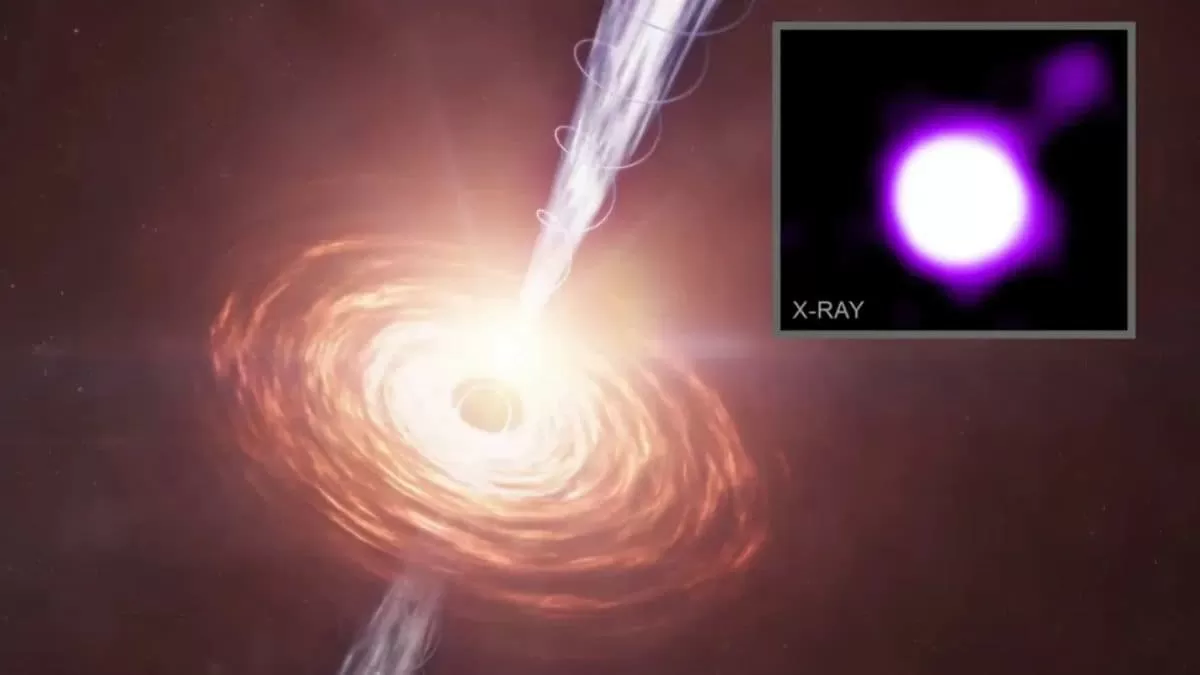
NASA’s Chandra X-ray Observatory has been making groundbreaking discoveries since its launch in 1999. Recently, it has detected a massive X-ray jet from quasar J1610+1811, located 11.6 billion light-years away. This incredible discovery has shed light on the behavior of black holes during the early era of the universe. However, despite its success, Chandra now faces potential defunding under NASA’s proposed budget. This has caused concern among astronomers who warn that cutting Chandra’s mission would be a huge setback for the scientific community.
The Chandra X-ray Observatory is one of NASA’s Great Observatories, along with the Hubble Space Telescope and the Spitzer Space Telescope. It is a powerful telescope that observes the universe in the X-ray spectrum, providing valuable insights into the most energetic and extreme objects in the cosmos. Over the years, Chandra has made numerous groundbreaking discoveries, including the first direct evidence of a black hole, the discovery of dark matter, and the detection of X-rays from a planet outside our solar system.
The recent discovery of a massive X-ray jet from quasar J1610+1811 is yet another testament to the capabilities of Chandra. Quasars are the brightest objects in the universe, powered by supermassive black holes at their centers. These black holes are surrounded by a disk of hot gas and dust, which emits intense radiation as it spirals towards the black hole. In the case of J1610+1811, Chandra’s observations have revealed a powerful jet of X-rays shooting out from the black hole at nearly the speed of light. This jet is estimated to be over 300,000 light-years long, making it one of the largest ever observed.
This discovery has provided valuable insights into the behavior of black holes during the early era of the universe. The quasar J1610+1811 is located 11.6 billion light-years away, which means that we are seeing it as it was when the universe was only 2.7 billion years old. This is a crucial time in the evolution of the universe, and Chandra’s observations have given us a glimpse into the extreme conditions that existed during this period. The X-ray jet from J1610+1811 is a powerful tool for studying the growth of supermassive black holes and their impact on their surrounding environment.
However, despite its success, Chandra’s future is uncertain. NASA’s proposed budget for the upcoming fiscal year includes a significant cut to the funding for the Chandra X-ray Observatory. This has caused concern among astronomers who fear that this could lead to the premature end of Chandra’s mission. The proposed budget cut would result in a reduction of staff and resources, making it difficult for Chandra to continue its operations.
Astronomers warn that cutting Chandra’s mission would be a huge blow to the scientific community. Chandra has been instrumental in advancing our understanding of the universe, and its contributions cannot be overstated. It has been at the forefront of many groundbreaking discoveries and has provided valuable data for thousands of research papers. Losing Chandra would mean losing a vital tool for studying the most energetic and extreme objects in the universe.
Moreover, the potential defunding of Chandra would also have a negative impact on the future of space exploration. Chandra is not just a telescope; it is a symbol of human ingenuity and our desire to explore the unknown. Its cutting-edge technology and groundbreaking discoveries have inspired generations of scientists and engineers. By defunding Chandra, we would be sending a message that we are not willing to invest in the advancement of science and exploration.
In conclusion, the recent discovery of a massive X-ray jet from quasar J1610+1811, 11.6 billion light-years away, is a testament to the capabilities of NASA’s Chandra X-ray Observatory. However, its future is now uncertain due to the proposed budget cuts. Astronomers warn that cutting Chandra’s mission would be a huge setback for the scientific community and a blow to the future of space exploration. It is our responsibility to ensure that Chandra’s mission continues, and we must urge NASA to reconsider its proposed budget cuts. Let us not hinder the progress of science and exploration, but instead, let us continue to push the boundaries of our knowledge and understanding of the universe.
