

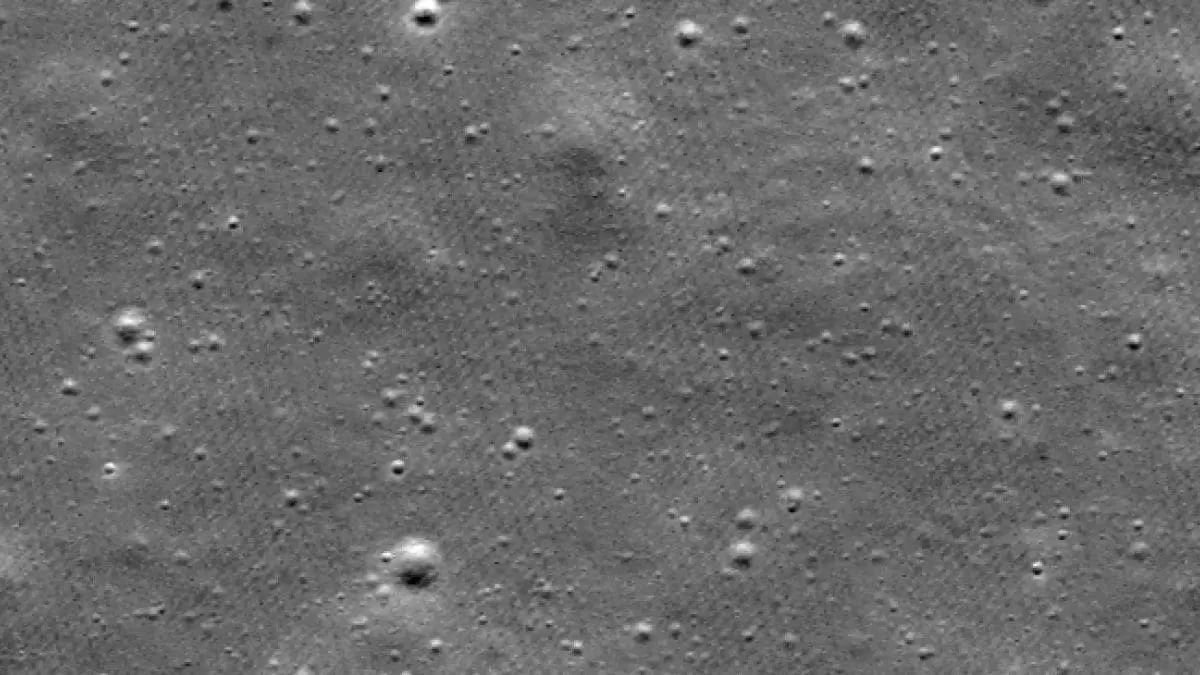
NASA’s Lunar Reconnaissance Orbiter (LRO) and India’s Chandrayaan-2 have recently captured images confirming the crash of Japan’s Resilience lander on the Moon’s Mare Frigoris. This news comes as a disappointment to the global space community, as the lander was set to make a historic touchdown on the lunar surface. However, despite the unfortunate outcome, the images captured by LRO and Chandrayaan-2 have provided valuable insights into the crash and its aftermath.
The Resilience lander, developed by the Japanese company ispace, was a part of a larger mission to explore the South Pole of the Moon. It was equipped with advanced instruments and was expected to gather crucial data and images from the lunar surface. The lander was launched on May 18, 2022, from the Tanegashima Space Center in Japan, along with two other landers from the United States and India.
Everything seemed to be going according to plan as Resilience approached the Moon’s surface on June 5, 2022. However, at just 100 seconds before its scheduled touchdown, the lander lost contact with the ground control team. This was a major setback for the Japanese space agency, JAXA, who had been working tirelessly on this mission for years.
Despite the loss of contact, the LRO and Chandrayaan-2 did not give up on their task. They continued to orbit the Moon and soon captured images of the crash site. The images revealed a dark impact mark and scattered debris, confirming the fate of the Resilience lander. This was a bittersweet moment for the teams at NASA and ISRO, as they were able to provide closure to the JAXA team and the global space community.
The LRO, which has been in orbit around the Moon for over a decade, has been instrumental in capturing high-resolution images of the lunar surface. Its Lunar Reconnaissance Orbiter Camera (LROC) has been able to capture images of the impact site with a resolution of just 0.5 meters per pixel. This has provided scientists with a detailed understanding of the crash and its impact on the lunar surface.
Chandrayaan-2, India’s second lunar mission, has also played a crucial role in capturing images of the crash site. The orbiter’s Terrain Mapping Camera-2 (TMC-2) has captured images with a resolution of 5 meters per pixel, providing a broader perspective of the impact area. This collaboration between NASA and ISRO highlights the global cooperation and support within the space community.
The images captured by LRO and Chandrayaan-2 have also revealed some interesting details about the crash. The dark impact mark suggests that the lander hit the surface of the Moon with a significant force, causing an explosion upon impact. The scattered debris further confirms the intensity of the crash. This information will be crucial for future missions to the Moon, as it will help in developing better landing techniques and technologies.
The crash of the Resilience lander has also raised questions about the challenges of landing on the Moon. With an increasing number of countries and private companies venturing into lunar exploration, it is essential to learn from these setbacks and improve our understanding of the lunar surface. The data and images captured by LRO and Chandrayaan-2 will contribute to this learning process and pave the way for successful future missions to the Moon.
Despite the disappointment of the failed landing, the Resilience mission has still achieved a significant milestone. It has become the first Japanese spacecraft to reach the lunar surface, and its orbiter is still functioning and capturing images from the Moon’s orbit. This is a testament to the hard work and dedication of the teams at JAXA and ispace.
The global space community has always faced challenges and setbacks in their pursuit of exploring the unknown. However, these setbacks only motivate us to work harder and strive for excellence. The collaboration between space agencies and the continuous advancements in technology have brought us closer to unlocking the mysteries of the Moon. And with each mission, we are one step closer to realizing our dream of sending humans to the Moon and beyond.
In conclusion, the images captured by NASA’s LRO and India’s Chandrayaan-2 have confirmed the crash of Japan’s Resilience lander on the Moon’s Mare Frigoris. While it is a setback for the global space community, the data and images captured
