

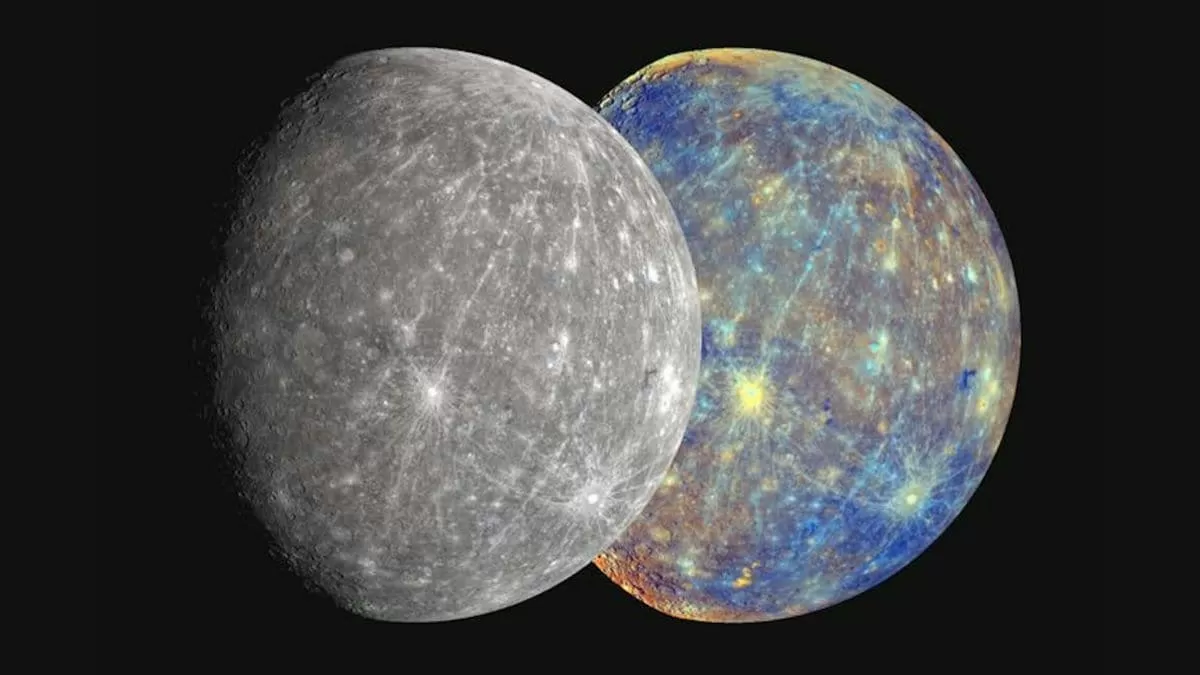
A groundbreaking new study has sparked excitement among scientists and space enthusiasts alike, as it suggests the possibility that two meteorites may have originated from the planet Mercury. This would be a first in history, if proven true. The meteorites, known as Ksar Ghilane 022 and NWA 15915, share remarkable similarities with the surface minerals of Mercury, but also present some differences that complicate a clear link.
The study, published in the journal Science Advances, was conducted by a team of researchers from the University of California, Los Angeles (UCLA) and the Tokyo Institute of Technology. They used advanced analytical techniques to examine the chemical makeup of the two meteorites and compare them to data from NASA’s Messenger spacecraft, which orbited Mercury from 2011 to 2015.
The results were astonishing. The researchers found that both meteorites contain high levels of sulfur, low levels of iron, and a unique mix of other elements that closely resemble the surface of Mercury. This is a significant discovery, as no other meteorites have been found to match the chemical composition of Mercury’s surface.
In addition to the chemical similarities, the researchers also noted that the two meteorites have a unique texture and mineralogy that further supports the possibility of their origin from Mercury. However, the study also revealed some differences between the meteorites and Mercury’s surface, which have left scientists scratching their heads.
One of the differences is the presence of an unusual mineral called sodalite in the meteorites. This mineral is not typically found on Mercury’s surface, but it is commonly found on Earth. This has led some scientists to speculate that the two meteorites may have originated from a different part of Mercury, such as its mantle, which could contain different minerals than its surface.
Furthermore, the researchers also found that the two meteorites contain a higher concentration of carbon than what has been observed on Mercury. This could suggest that the meteorites have undergone some alteration during their journey through the solar system, which could have affected their chemical makeup.
Despite these differences, the researchers are confident that the similarities between the meteorites and Mercury’s surface are too significant to be ignored. They believe that the meteorites may have originated from a volcanic eruption on Mercury, which launched them into space and eventually brought them to Earth.
This study has opened up a whole new realm of possibilities in the field of meteoritics. Until now, it was believed that meteorites only originated from the Moon, Mars, and asteroids. If the link between these two meteorites and Mercury can be confirmed, it would be the first time in history that a meteorite has been identified as coming from the innermost planet of our solar system.
The implications of this discovery are far-reaching. It would not only provide valuable insights into the geological history of Mercury, but it could also shed light on the formation and evolution of our solar system. Moreover, it could pave the way for future missions to Mercury, as scientists would have a better understanding of what to look for and where to find it.
However, before we can definitively say that these meteorites originated from Mercury, further research and analysis are needed. The researchers are planning to examine more meteorites and compare them to data from other spacecraft that have studied Mercury, such as NASA’s Mariner 10 and MESSENGER missions.
In the meantime, the possibility of these two meteorites originating from Mercury has sparked excitement and curiosity in the scientific community. It serves as a reminder that there is still so much to learn about our solar system and the mysteries that lie beyond.
The study also highlights the importance of meteorites in helping us understand the history of our solar system. These fragments of space debris may seem insignificant, but they hold valuable information that can unlock the secrets of our universe.
In conclusion, the discovery of two meteorites with a possible link to Mercury is a remarkable achievement that has the potential to change our understanding of our solar system. While there are still many questions to be answered and further research to be conducted, this study has opened up a whole new world of possibilities. Who knows what other secrets these space rocks may hold? The sky is truly the limit.
