


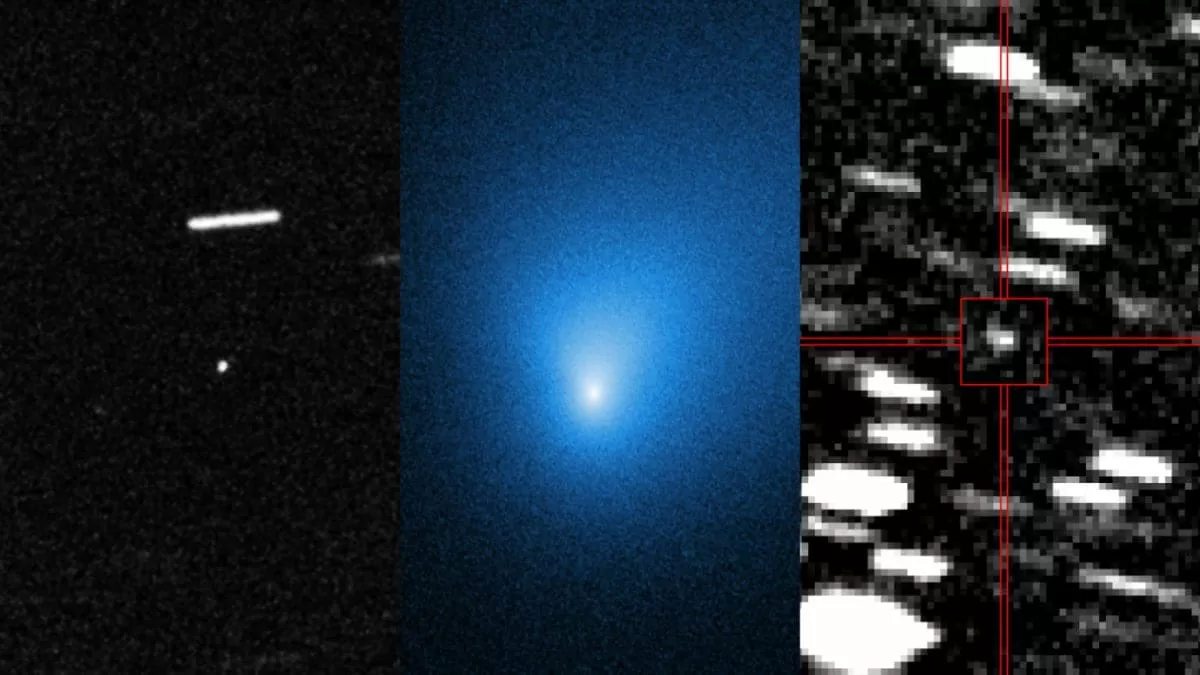
The vastness of the universe never fails to amaze us. It is home to countless stars, planets, and other celestial bodies, each holding its own secrets and mysteries. Recently, astronomers have made an incredible discovery that has once again sparked our curiosity and fascination with the cosmos. They have detected a new interstellar object, 3I/ATLAS, making its way through our solar system.
This is not the first time an interstellar object has passed through our neighborhood. In 2017, the first known interstellar object, named ‘Oumuamua, was discovered. It was followed by the second one, known as 2I/Borisov, in 2019. Now, 3I/ATLAS joins this exclusive list as the third interstellar comet to visit our solar system. But what makes this discovery even more exciting is its size and speed.
The comet was first observed by the Asteroid Terrestrial-impact Last Alert System (ATLAS) telescope in Chile. The telescope, designed to scan the skies for potentially hazardous asteroids, caught a glimpse of this interstellar object in April 2020. Initial observations suggested that it was a typical comet, but further studies revealed something extraordinary.
According to astronomers, 3I/ATLAS is racing towards the Sun at a staggering speed of 150,000 miles per hour. It is expected to reach its closest point to the Sun in October, after which it will begin its journey back into the depths of space. This journey will take the comet thousands of years, providing us with a once-in-a-lifetime opportunity to study it.
But what makes this interstellar comet truly special is its estimated size. The comet is estimated to be between 10 to 20 kilometers across, making it the largest interstellar object observed so far. To put things into perspective, ‘Oumuamua was only about 800 meters long, while 2I/Borisov was around 2 kilometers in size. This makes 3I/ATLAS almost ten times larger than the previous two interstellar objects.
The discovery of 3I/ATLAS has already provided astronomers with valuable insights into the nature of interstellar objects. The comet’s composition, structure, and trajectory can help us understand the conditions in which it was formed and the journey it has undertaken to reach our solar system. It will also allow us to compare and contrast it with the other interstellar objects, helping us unravel the mysteries of our universe.
Moreover, the comet’s close encounter with the Sun has also revealed signs of cometary activity. As it nears the Sun, the frozen gases and dust on its surface begin to vaporize, creating a tail of gas and dust that extends millions of kilometers into space. This cometary activity is a telltale sign that 3I/ATLAS is indeed a comet and not an asteroid, as initially thought.
The discovery of 3I/ATLAS serves as a reminder of the incredible advancements in technology and our understanding of the universe. It also highlights the importance of collaboration and cooperation among scientists from different countries and organizations. The data collected from various telescopes and satellites, including NASA’s Hubble Space Telescope, has been vital in studying this interstellar comet.
But this discovery also poses new questions. How many more interstellar objects are out there, waiting to be discovered? What secrets do they hold, and how can we uncover them? As we continue to explore and study our universe, we can only imagine what other surprises it holds for us.
In the meantime, 3I/ATLAS will continue its journey through our solar system, providing us with incredible opportunities to learn and expand our knowledge about the cosmos. This latest interstellar visitor has captured our imagination and sparked our curiosity, reminding us of the limitless wonders that await us in the great expanse of space.
In conclusion, the discovery of 3I/ATLAS is a significant milestone in our quest to understand the universe. Its size, speed, and cometary activity make it a unique and fascinating object for astronomers to study. As it zooms through our solar system, it reminds us of the vastness and complexity of our universe, igniting our passion for exploration and discovery.
