


For centuries, Betelgeuse has been a source of wonder and fascination for astronomers and stargazers alike. This bright red star, located in the constellation of Orion, has captivated our imagination with its mysterious dimming cycles. But after years of speculation and theories, astronomers have finally solved the puzzle of Betelgeuse’s six-year dimming cycle, thanks to a groundbreaking discovery.
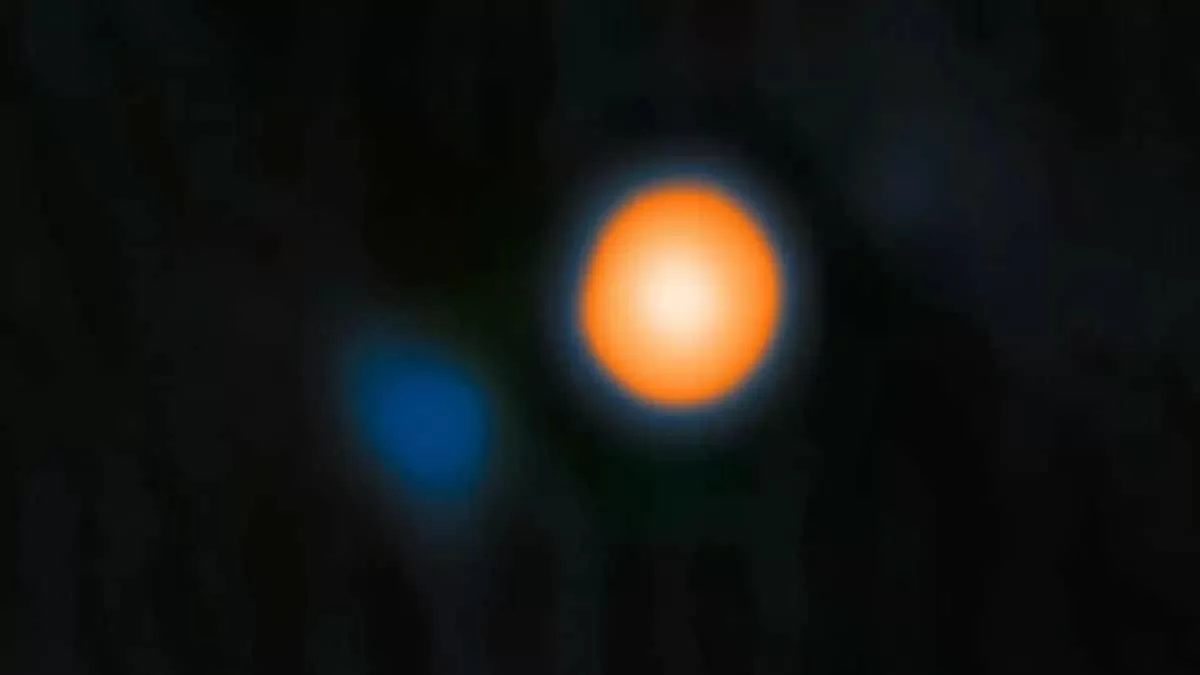
Using the advanced imaging capabilities of the Gemini North telescope, researchers have captured the first-ever image of Betelgeuse’s hidden companion star. This long-awaited discovery has shed light on the enigmatic nature of this red supergiant and has opened up new avenues for understanding the complex systems of these massive stars.
Betelgeuse, also known as Alpha Orionis, is one of the largest and brightest stars in the night sky. It is a red supergiant, meaning it is nearing the end of its life and is in the process of expanding and cooling. This makes it an ideal candidate for studying the final stages of a star’s life cycle. However, Betelgeuse has always been a bit of an enigma due to its irregular dimming cycles, which have puzzled astronomers for over a thousand years.
The dimming of Betelgeuse was first recorded by Chinese astronomers in 1300 AD, and since then, it has been observed numerous times by astronomers around the world. However, the cause of this dimming has remained a mystery, with some speculating that it could be due to dust clouds or changes in the star’s internal structure.
But now, thanks to the powerful imaging capabilities of the Gemini North telescope, astronomers have been able to get a closer look at Betelgeuse and its surroundings. The telescope, located on Mauna Kea in Hawaii, uses adaptive optics technology to correct for the blurring effects of Earth’s atmosphere, allowing for incredibly sharp and detailed images of celestial objects.
In a recent study published in the journal Nature, a team of researchers led by Dr. Andrea Dupree of the Harvard-Smithsonian Center for Astrophysics, revealed the first-ever image of Betelgeuse’s companion star. The image, captured in infrared light, shows a faint star orbiting deep within Betelgeuse’s atmosphere.
This companion star, which has been named Betelgeuse B, is about the size of our sun and orbits Betelgeuse at a distance of about 4 astronomical units (AU). This is equivalent to four times the distance between the Earth and the sun. The researchers believe that this companion star is the key to understanding Betelgeuse’s mysterious dimming cycles.
According to Dr. Dupree, Betelgeuse B is most likely a low-mass star that is in a symbiotic relationship with Betelgeuse. As Betelgeuse expands and loses mass, its companion star feeds off this material, causing the irregular dimming that has been observed. This discovery not only solves the mystery of Betelgeuse’s dimming, but it also offers new insights into the complex interactions between stars in binary systems.
But this is not the only exciting aspect of this discovery. The image of Betelgeuse’s companion star also provides valuable information about the internal structure and evolution of red supergiants. By studying the orbit and properties of Betelgeuse B, researchers can gain a better understanding of how these massive stars evolve and eventually die.
This groundbreaking discovery is a testament to the power of advanced imaging technology and the tireless efforts of astronomers around the world. It also highlights the importance of continued investment in scientific research and exploration, as it has the potential to unlock the secrets of our universe and expand our understanding of the world around us.
With this new information, astronomers can now continue to study Betelgeuse and its companion star in even more detail, providing us with a deeper understanding of these fascinating celestial objects. Who knows what other mysteries and wonders are waiting to be discovered in the vast expanse of our universe.
So the next time you look up at the night sky and spot the bright red star of Betelgeuse, remember that there is much more to this celestial beauty than meets the eye. Thanks to the perseverance and dedication of astronomers, we can now unravel the mysteries of this star and gain a better understanding of the complex systems that make up our universe.
