


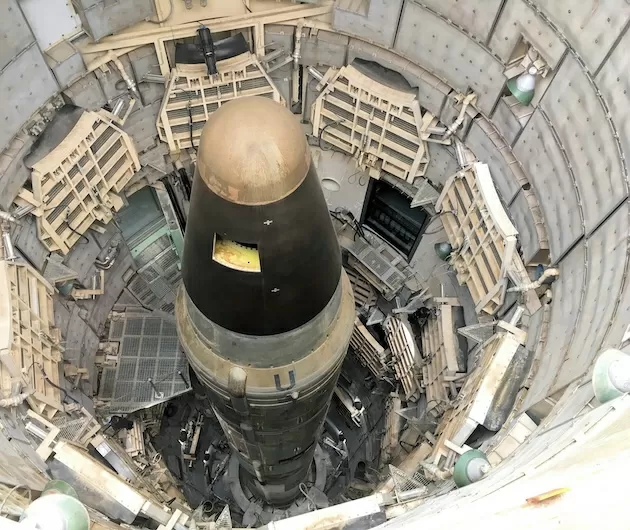
In recent days, the world has become increasingly worried about the rising tensions between nuclear state leaders and their disregard for regulations and norms around nuclear non-proliferation. The constant threat of nuclear war has once again loomed large as countries like the United States and the Russian Federation have openly displayed their nuclear might in the name of projecting strength.
On the 27th of October, President Vladimir Putin announced the successful test-launch of a new intercontinental ballistic missile, the Sarmat. This missile is said to be capable of carrying multiple nuclear warheads and has a range that can reach anywhere in the world. This display of military might was accompanied by a video animation showing Russia’s nuclear arsenal targeting Florida, the location of President Trump’s Mar-a-Lago resort. This provocative move by Russia was seen as a direct challenge to the United States’ military superiority.
In response, on the 1st of November, the United States carried out a successful test of an upgraded version of its B61 nuclear bomb, the most powerful in its arsenal. This move was seen as a message to Russia that the United States is just as capable of retaliating and maintaining its dominance in the nuclear arena. This renewed show of power by the two nuclear superpowers has sent shockwaves across the world and raised concerns about the possibility of another Cold War era.
This recent display of nuclear posturing by the United States and Russia is just the latest in a series of events that have challenged the established norms and regulations around nuclear weapons. In July of this year, the United States withdrew from the Intermediate-Range Nuclear Forces (INF) Treaty, which banned the deployment of nuclear-capable missiles with a range of 500 to 5,500 kilometers. This move was followed by Russia’s suspension of the treaty, leading to a further deterioration of relations between the two countries.
The disregard for nuclear non-proliferation has also been displayed by other nuclear states, such as North Korea and India. North Korea’s continued development and testing of nuclear weapons has been a cause of concern for the international community, with the country’s leader, Kim Jong-un, openly threatening to use these weapons against his perceived enemies. In addition, India’s recent successful test of a ballistic missile with a range of 5,000 kilometers is another indication of the growing nuclear ambitions of some countries.
As these countries continue to flout regulations and norms around nuclear weapons, the fear of a nuclear conflict is becoming more and more real. The use of nuclear weapons would have catastrophic consequences for the entire world, leading to the loss of millions of lives and irreparable damage to the environment.
It is imperative that world leaders take immediate action to address this growing threat. The first step towards this would be the reaffirmation of commitment to nuclear non-proliferation and disarmament by the nuclear states. This would send a strong message to the rest of the world and encourage other countries to follow suit.
Furthermore, there needs to be a greater effort to negotiate and implement new treaties and agreements that will limit the development and deployment of nuclear weapons. The renewal of the New Strategic Arms Reduction Treaty (START) between the United States and Russia, which is set to expire in 2021, is crucial in this regard. This treaty has been instrumental in reducing the nuclear arsenals of both countries and has played a significant role in maintaining global stability.
In addition, there needs to be a greater focus on building trust and improving communication between nuclear states. This will help to prevent misunderstandings and miscalculations that could potentially lead to a nuclear conflict. Dialogue and diplomacy must be prioritized over displays of military might and aggression.
Finally, the public needs to be educated about the dangers of nuclear weapons and the importance of nuclear non-proliferation. Governments must also take steps to reduce the perceived importance of nuclear weapons in national security strategies and instead focus on diplomatic solutions to international conflicts.
In conclusion, the recent displays of nuclear posturing by nuclear state leaders are a cause for concern and should be a wake-up call to the international community. The world cannot afford another nuclear arms race or worse, a nuclear war. It is the responsibility of all nations, especially those with nuclear capabilities, to work towards a world free from the threat of nuclear weapons. The time to act is now, before it is too late.
