


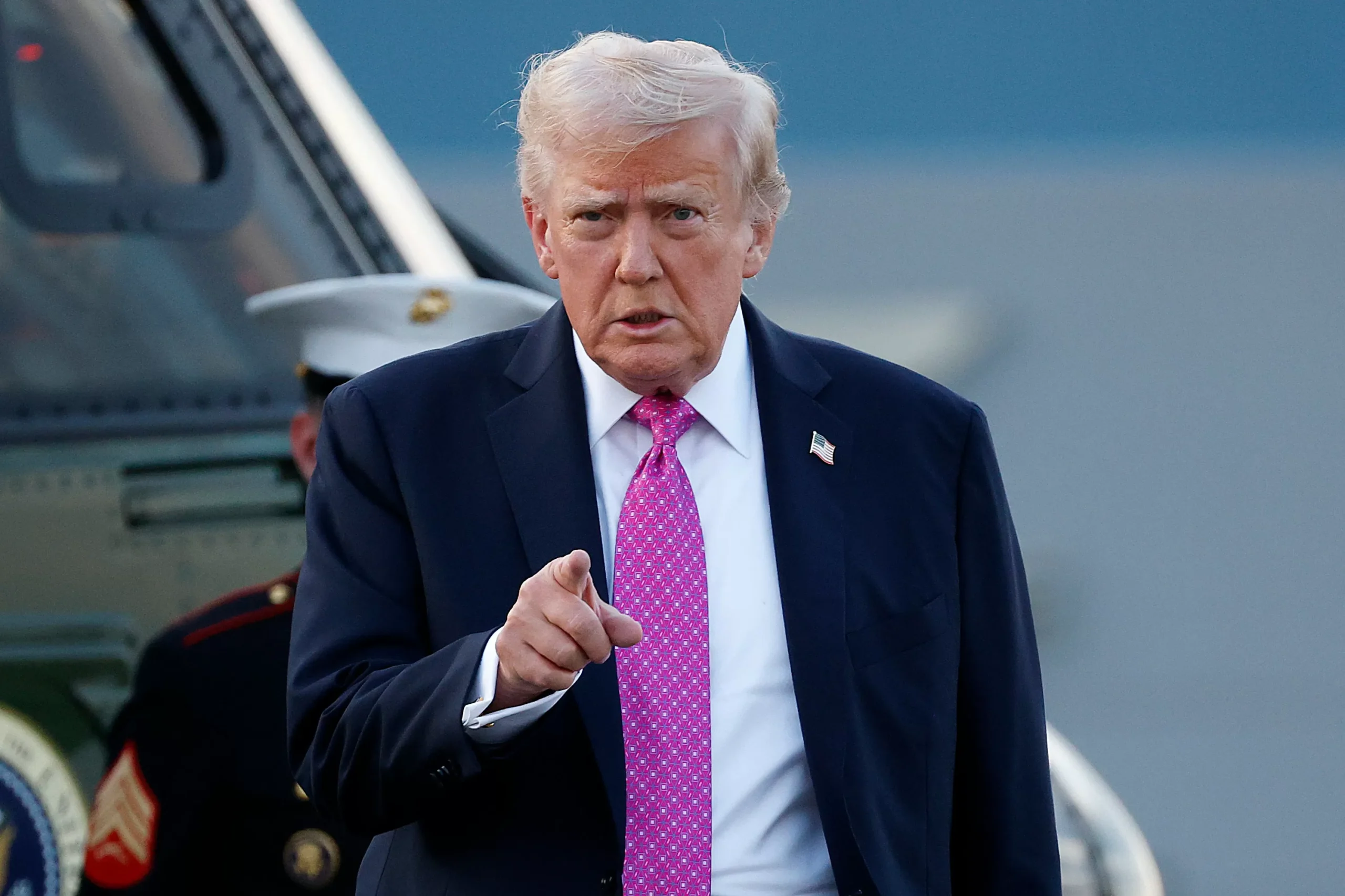
US President Donald Trump made headlines once again this week, as he walked to Air Force One at Morristown Airport on September 14, 2025 in Morristown, New Jersey. Trump was returning to Washington, DC after a trip to New York and his golf club in Bedminster, New Jersey. But it wasn’t just his routine travels that caught the attention of the world – it was his bold and aggressive actions that have left many in awe.
The week started with Trump initiating military strikes against Venezuela and capturing its president Nicolas Maduro. But he didn’t stop there. He declared that he would “run” the country and send in America’s oil companies. While there were some murmurs of dissent over this aggression, his western allies effectively looked the other way, shirking questions over whether this was a breach of international law.
But Trump wasn’t finished. He then began to renew his threats against Colombia, Cuba, Mexico, and Iran – as well as the Danish territory of Greenland. This move would effectively tear apart the North Atlantic Treaty Organization (NATO), as both the US and Denmark are members. In an interview with the New York Times, Trump even stated that he could be left with a “choice” between sticking with NATO or grabbing Greenland.
The 80-year pact among western leaders after World War 2 to commit to a shared idea of defense, democracy, and law has seemingly gone out the window. And while there have been some murmurs of dissent from European leaders, they fear the repercussions that could follow if they challenge the most powerful man in the world for upending the rules-based order.
Is it now Trump’s world, and are we just living in it? According to Keir Giles, associate fellow of the Russia and Eurasia Programme, it certainly seems that way. He points out that the US is widely seen as the main enforcer of international law, and as a result, America has been able to pick and choose which elements it wants to uphold – or now let collapse altogether.
But Giles also suggests that Europe may be less powerful than it thinks, and that the continent needs to have a strategy that goes beyond “pandering” to the White House. It’s clear that the softly-softly approach is barely registering with Trump, as seen from UK Prime Minister Keir Starmer’s interactions with him this week.
Starmer has tried to become a Trump whisperer over the last 18 months, but he couldn’t even get the US president on the phone in the immediate aftermath of his military strikes on Venezuela. It seemed that it was only after the UK and France promised to send their troops to Ukraine in the event of a peace deal and Britain helped the US seize a Russian tanker linked to Venezuelan oil in the North Atlantic that Trump picked up the phone on Wednesday.
And even then, it was clear that Starmer made no progress on persuading Trump to back down on his Greenland ambitions. In a surprising turn of events, the two leaders had a second conversation on Thursday. According to Downing Street, they discussed Euro-Atlantic security and agreed on the need to deter an increasingly aggressive Russia in the High North. But Trump’s response to those words from Starmer was notably absent.
There are growing calls for European leaders to grow a backbone, especially if Trump moves to annex Greenland. As EU correspondent Ole Ryborg wrote for Danish media outlet DR, “What the Europeans have not tried yet is to act against the US. The political will has not been there.” He suggests that if Europe banded together against the US, it could use its “large arsenal of very powerful weapons” to knock Trump off course.
Ryborg notes that the EU could start an economic conflict by halting the export of specific technology that the US buys in Europe, which could block the entire US AI sector. The bloc could also stop using American cryptocurrency, impose personal sanctions on Americans, implement an entry ban on US politicians, freeze financial assets, limit the new purchase of American government bonds, restrict US companies and services, and disrupt the US-EU medicine trade. Even closing US military bases in Europe would send a strong message to the White House.
It’s clear that it’s in Europe’s best interest to stop Trump sooner rather than later – and not just because of Greenland. Trump’s moves have also given Russia a boost. On Thursday, Russia targeted western Ukraine, Lviv, with an intermediate-range ballistic missile that traveled approximately 1
