


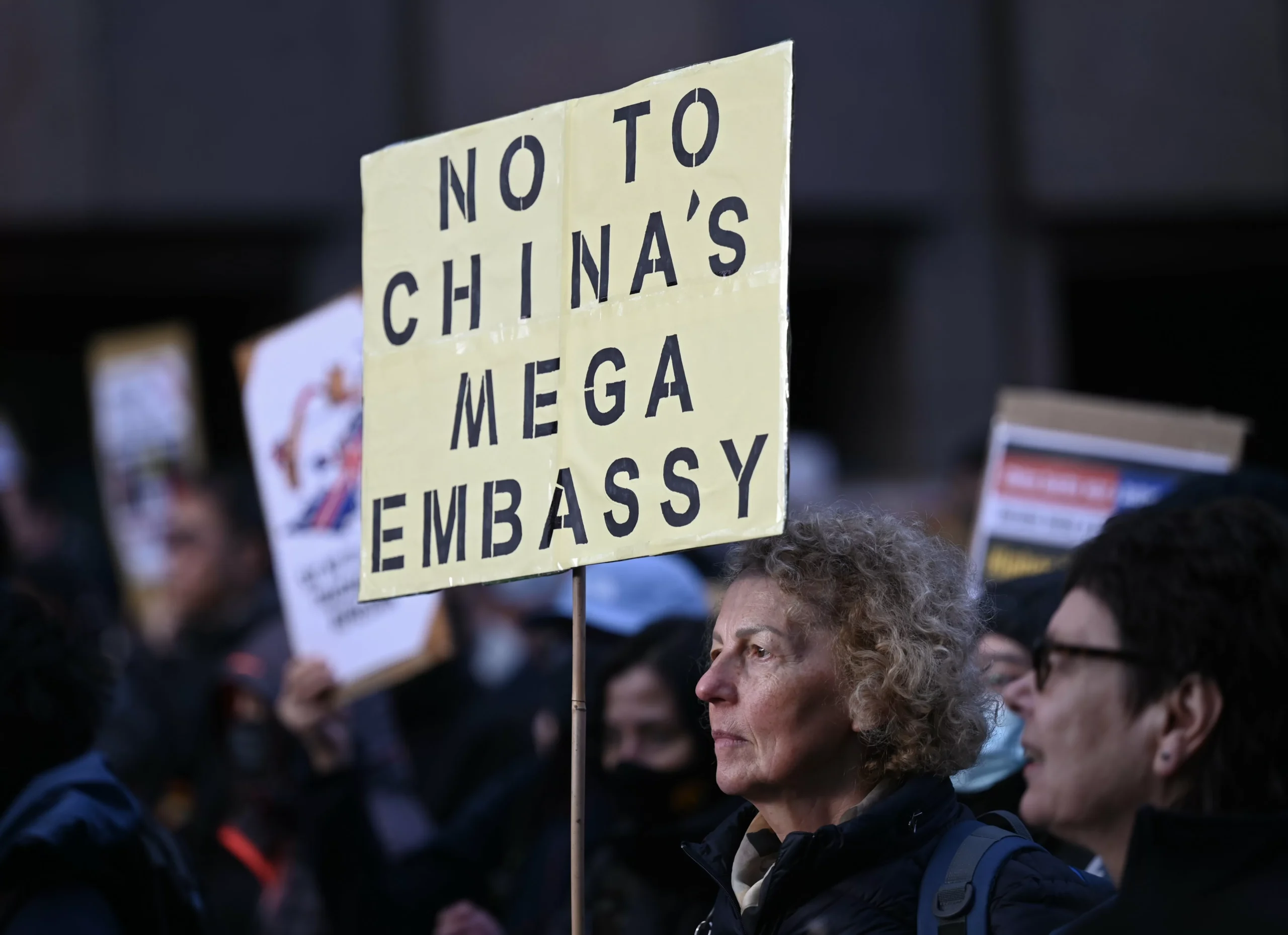
Demonstrators gathered in London on Saturday, January 17, 2026 to protest against the opening of a new Chinese embassy. The protest comes after years of pushback from concerned critics who feared that the mega-embassy would be used for espionage, to intimidate dissidents, or to disrupt the UK’s sensitive financial cabling. However, despite these fears, the government has finally given its approval for the construction of the embassy, leading to a mix of reactions and concerns from the public.
The proposed embassy will be located on the old Royal Mint Court near the Tower of London, replacing seven separate buildings across the city. With a total area of 20,000 square meters, it will be the biggest embassy of its kind in Europe and will be situated near the fiber optic cables that carry highly sensitive data for the UK financial sector. China has been pushing for this mega-embassy since 2018 when they first bought the site for £255 million. It is also expected that Chinese diplomats will live on site.
However, these construction plans faced a roadblock when they were rejected by the Tower Hamlets Council in 2022 due to safety concerns. Beijing then resubmitted the application in 2024, and the Labour government finally gave its approval on Tuesday. This decision has raised questions about the security implications of such a large Chinese presence in the heart of London.
The timing of the government’s approval has also raised eyebrows, as it comes just days before Prime Minister Keir Starmer’s visit to China at the end of the month. Starmer will be the first UK prime minister to visit China since Theresa May in 2018. Rejecting the plan could have put diplomatic relations under pressure and jeopardized the government’s plans to repair its relationship with China. The UK is also waiting for approval for its own £100 million plan to redevelop the British embassy in Beijing.
Despite these concerns, government officials insist that the UK’s national security will remain protected. The Prime Minister’s official spokesperson stated, “National security is the number one priority.” He further explained that the Home Office and Foreign Office were both consulted during the planning process, and any potential security issues were addressed and resolved.
However, not everyone is convinced that the government has thoroughly considered the security implications of the mega-embassy. Kevan Jones, the chairman of Parliament’s intelligence and security committee, claimed that the government had not gone through a “robust” enough process before granting approval. Jones, who sits as Lord Beamish, said, “We were surprised by the lack of clarity on the role of national security considerations in planning decisions, and the fact that key reports lacked necessary details and were not kept up to date.”
The committee also pointed out that China continues to pose a threat to the UK’s national security and expressed concerns about the government’s ability to reconcile the fact that China can be both an economic partner and a national security threat.
One of the main concerns surrounding the mega-embassy is the possibility of “secret rooms” being installed and used for spying. However, the government has stated that they have seen the unredacted plans and are satisfied that the embassy will not be used for such purposes. The Prime Minister’s spokesperson clarified, “Classified facilities are a standard part of any significant diplomatic presence, including British embassies. The government has seen the plans, and we are content that any risks are being appropriately managed.”
Security Minister Dan Jarvis refused to disclose the specific grounds on which the embassy was approved, citing potential legal proceedings. However, he confirmed that the government has agreed with China that the “publicly accessible forecourt” on the embassy grounds would not have diplomatic immunity. “Based on all of this and our extensive work on this matter, I am content that any risks are being appropriately managed,” Jarvis said.
Another concern is the embassy’s proximity to fiber optic cables that carry sensitive data for the City of London companies. The UK housing department has rejected claims that the site would interfere with the cables, stating that national security bodies have not raised any concerns about the embassy’s proximity to the cables.
Opposition parties have responded negatively to the government’s decision. Liberal Democrat foreign affairs spokesperson Calum Miller called it Starmer’s “biggest mistake yet.” He stated, “The Prime Minister knows his decision today will amplify China’s surveillance efforts here in the UK and endanger the security of our data – not to speak of the safety of the brave Hong
