


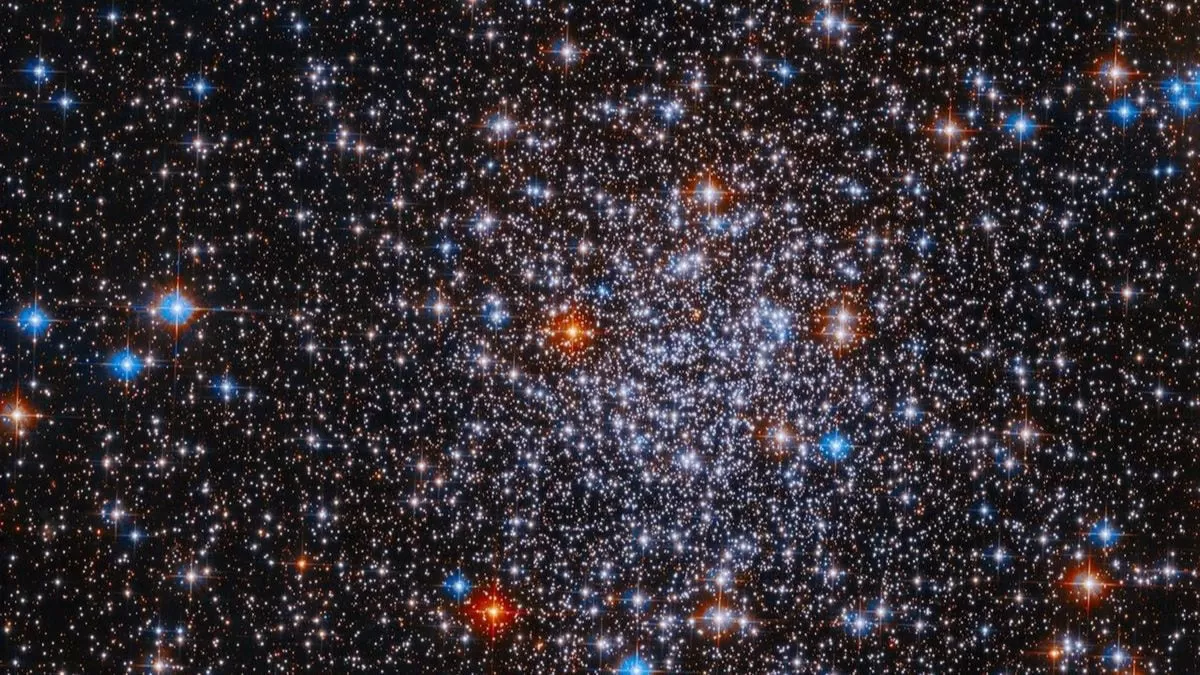
NASA’s Hubble Space Telescope has once again amazed us with a stunning discovery – a long-overlooked globular cluster known as ESO 591-12. This cluster, filled with multicolored stars, was captured during a survey of missing clusters and has provided new insight into stellar evolution and the early Milky Way. This image marks a vital step in resolving the structure and origin of ancient star systems hidden within our galaxy.
Globular clusters are some of the oldest and most densely packed star systems in the universe. They are made up of hundreds of thousands, and sometimes even millions, of stars that are tightly bound together by gravity. These clusters are often found in the outskirts of galaxies, including our own Milky Way.
ESO 591-12, located in the constellation of Scorpius, was first discovered in 1976 by the European Southern Observatory’s (ESO) Schmidt telescope. However, it was largely ignored until now due to its faintness and location in a crowded region of the sky. But thanks to the Hubble Space Telescope’s powerful capabilities, this cluster has finally been brought into the spotlight.
The image captured by Hubble shows a dazzling display of stars, ranging in color from blue to red. This indicates that the stars in ESO 591-12 have different ages and temperatures. The blue stars are younger and hotter, while the red stars are older and cooler. This provides valuable information about the cluster’s evolution and the early stages of star formation in our galaxy.
But what makes this discovery even more significant is the fact that ESO 591-12 is one of the missing globular clusters that astronomers have been searching for. These clusters are believed to be remnants of the early Milky Way, formed when our galaxy was still in its infancy. By studying these ancient star systems, scientists can gain a better understanding of how our galaxy evolved over billions of years.
The Hubble Space Telescope’s survey of missing clusters is part of a larger project called the Hubble Catalog of Variables (HCV). This project aims to create a comprehensive catalog of variable stars, which are stars that change in brightness over time. By studying these stars, astronomers can learn more about their properties and the processes that drive their evolution.
ESO 591-12 is just one of the many treasures that have been uncovered by the HCV project. With its high-resolution images and advanced technology, the Hubble Space Telescope has revolutionized our understanding of the universe and continues to make groundbreaking discoveries.
This latest finding also highlights the importance of continued exploration and research in the field of astronomy. By pushing the boundaries of our knowledge, we are able to unlock the secrets of the universe and gain a deeper understanding of our place in it.
The Hubble Space Telescope, which has been in operation for over 30 years, has played a crucial role in expanding our understanding of the cosmos. Its ability to capture images with incredible detail and clarity has allowed us to see the universe in a whole new light. And with the upcoming launch of the James Webb Space Telescope, we can expect even more groundbreaking discoveries in the years to come.
The discovery of ESO 591-12 is a testament to the power of human curiosity and our relentless pursuit of knowledge. It reminds us that there is still so much to discover and explore in the vast expanse of space. And as we continue to unravel the mysteries of the universe, we are constantly reminded of the beauty and wonder that surrounds us.
In conclusion, NASA’s Hubble Space Telescope has once again astounded us with a remarkable discovery – the long-overlooked globular cluster ESO 591-12. This image not only provides new insights into stellar evolution and the early Milky Way, but also marks a significant step in our quest to understand the structure and origin of ancient star systems hidden within our galaxy. It serves as a reminder of the incredible capabilities of the Hubble Space Telescope and the endless possibilities that lie ahead in the field of astronomy.
