Dover Road Blockade: Masked Vigilantes Warn of Return
Escalating Tensions Over Port Disruptions
The Dover road blockade orchestrated by masked activists has sparked urgent warnings from political leaders and civil rights organizations, who caution that similar demonstrations could recur unless law enforcement substantially strengthens its response. The group responsible for the high-profile disruption, Patriot Platform, has openly suggested the blockade represents merely the opening chapter in a broader campaign of coordinated action.
Patriot Platform, an organization with documented connections to far-right movements across Europe, framed the Dover road blockade as a spontaneous uprising driven by grassroots sentiment. The group's public messaging emphasizes nationalist themes and presents itself as defenders of traditional British values, employing rhetoric centered on immigration concerns and national identity.
Police Response Under Scrutiny
Hope Not Hate's leadership has directly attributed the group's capacity to mobilize participants at significant scale to what they characterize as systematic police hesitancy in confronting extremist organizing. The anti-racism charity argues that insufficient enforcement creates an environment where such organizations feel emboldened to stage further disruptions.
The timing of the Dover road blockade, occurring during heightened debate about immigration policy, has intensified scrutiny on how authorities manage demonstrations involving masked participants. Officials have faced criticism from multiple directions—some demanding harsher responses to extremist activity, while others raise concerns about proportionality and free expression protections.
Masked Protesters and Identification Challenges
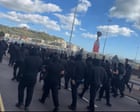
The deliberate use of balaclavas and coordinated black attire by participants in the Dover road blockade complicated initial identification efforts and raised questions about preparedness in security planning. The uniformity of appearance suggested organizational coordination, contradicting claims of spontaneous public action.
Legal experts have noted that current legislation provides authorities with tools to address face-covering tactics during demonstrations, yet enforcement remains inconsistent. The Dover road blockade episode illustrated gaps between regulatory frameworks and practical application, particularly regarding identification of organizers versus individual participants.
Far-Right Movement Implications
Patriot Platform's claimed responsibility for the Dover road blockade represents a significant escalation in public visibility for groups operating within Britain's far-right ecosystem. The organization has strategically positioned itself as distinct from more overtly extremist entities, adopting mainstream political language about immigration while maintaining ideological continuity with traditional far-right nationalism.
Researchers monitoring extremist movements note that the Dover road blockade demonstrates evolving tactical approaches within these circles. Rather than confrontational street violence, groups increasingly employ coordinated but technically legal assemblies designed to generate media attention and test institutional responses.
Political Implications and Future Prospects
Government ministers have condemned the Dover road blockade while emphasizing commitment to maintaining public order and protecting democratic freedoms. However, political divisions have emerged regarding appropriate responses, with some calling for enhanced surveillance and prosecution capabilities, while others warn against measures that could normalize expanded police powers.
The Dover road blockade has intensified pressure on local authorities to develop comprehensive strategies addressing both immediate security concerns and underlying organizational capacity of extremist movements. Prevention-focused approaches emphasizing community engagement compete with enforcement-centered models demanding stricter prohibitions on masked demonstrations.
Community Response and Civil Society
Citizen groups and anti-racist organizations have mobilized counter-messaging campaigns following the Dover road blockade, attempting to prevent radicalization and delegitimize Patriot Platform's nationalist narrative. These efforts emphasize inclusive British identity frameworks and economic arguments countering anti-immigration rhetoric.
The Dover road blockade has reinvigorated discussions about community resilience and civil society's role in addressing extremist mobilization. Multiple organizations are developing educational initiatives and interfaith programming designed to prevent recruitment and strengthen social cohesion across demographic divides.
Surveillance and Intelligence Capabilities
Security professionals have highlighted intelligence failures preceding the Dover road blockade, questioning whether law enforcement agencies possessed adequate warning of coordinated activity. Future prevention efforts will likely emphasize enhanced information-sharing protocols and earlier intervention strategies targeting organizational infrastructure rather than individual participants.
The Dover road blockade experience suggests police forces must substantially upgrade capacity for monitoring far-right organizing on digital platforms while respecting civil liberties and avoiding discriminatory surveillance practices.