


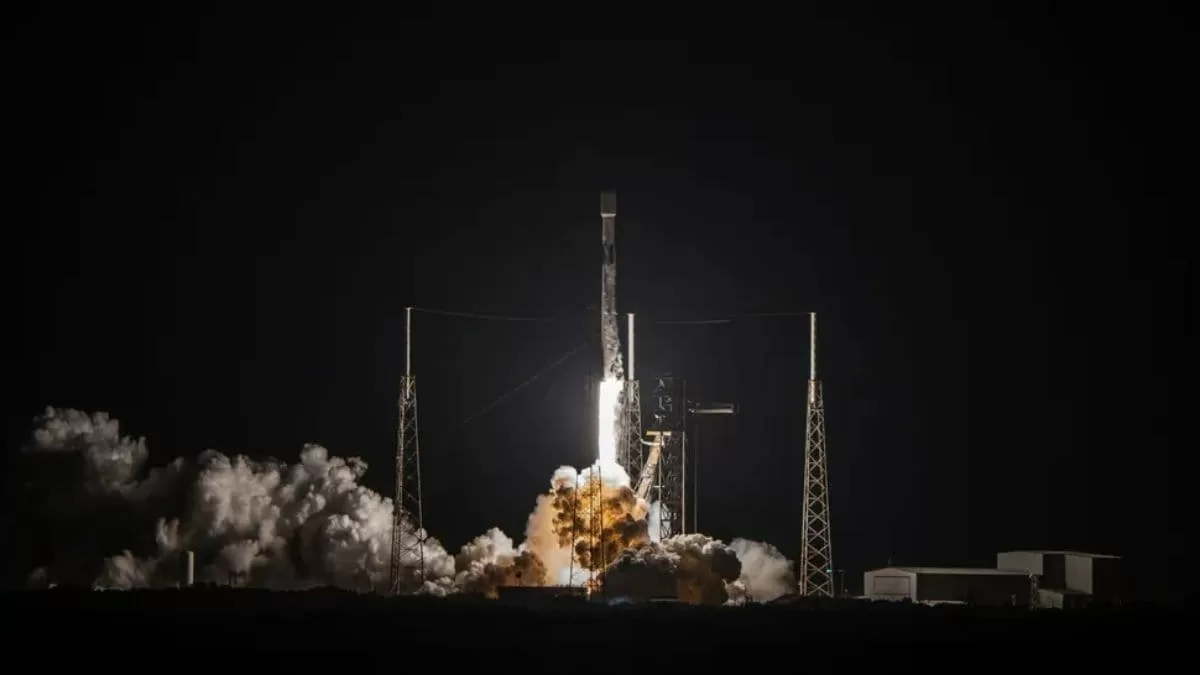
SpaceX, the innovative space exploration company founded by Elon Musk, continues to make waves in the industry with its latest achievement. On Sunday, December 19th, the Falcon 9 rocket successfully launched 28 Starlink satellites into low-Earth orbit from Florida’s Cape Canaveral Space Force Station. This marks the 34th Starlink mission for 2025 and brings the total number of satellites in the Starlink megaconstellation to over 1,800.
The Falcon 9 rocket lifted off at 8:45 a.m. EST, lighting up the sky and dazzling spectators with its powerful engines. The launch was closely followed by millions of people worldwide, eager to witness the next step in SpaceX’s journey towards providing global high-speed internet access.
The booster B1080, which was used for the mission, has already proven its reliability with this being its 18th flight. After successfully delivering the satellites into orbit, the booster returned to Earth and made a perfect landing on a drone ship in the Atlantic Ocean. This marks the 87th successful landing of a SpaceX booster, further solidifying the company’s expertise and technological advancements in reusable rocket technology.
These 28 new Starlink satellites are equipped with the latest upgrades, including laser crosslinks, which allows the satellites to communicate with each other and ground stations, improving the speed and efficiency of the network. The satellites also have upgraded solar arrays, which will enable them to generate more power and operate for a longer period in orbit.
The primary goal of the Starlink megaconstellation is to provide high-speed internet access to even the most remote and underserved parts of the globe. With each successful launch, SpaceX gets one step closer to achieving this goal. The company has already begun beta testing its internet service in select areas, and the feedback has been overwhelmingly positive. Users have reported speeds of up to 150 Mbps, significantly faster than traditional satellite internet services.
The demand for reliable and high-speed internet has never been higher, especially with the ongoing global pandemic, which has forced people to work and study from home. SpaceX’s Starlink aims to bridge this digital divide and provide internet access to areas where traditional infrastructure is not feasible or economical.
One of the most significant advantages of Starlink is its low latency, which refers to the time it takes for data to travel from the user’s device to the satellite and back to Earth. Traditional satellite internet services have high latency, making activities like video conferencing and online gaming nearly impossible. With Starlink, the latency is significantly reduced, making it comparable to other high-speed internet options like fiber-optic and cable.
Moreover, the Starlink network is continuously expanding and improving. With each launch, more satellites are added to the constellation, increasing coverage and capacity. SpaceX plans to have over 12,000 satellites in orbit by the mid-2020s, providing global coverage.
Apart from providing internet access, the Starlink megaconstellation also has the potential to revolutionize other industries, such as emergency services, weather monitoring, and disaster response. The laser crosslinks on the satellites can also be used for secure and fast communication between different organizations and countries.
SpaceX’s success with the Starlink project has not gone unnoticed. Other companies, such as Amazon’s Project Kuiper and OneWeb, have also announced plans to launch their satellite internet networks. However, SpaceX’s head start and proven track record give it a competitive edge in this emerging market.
In addition to the Starlink missions, SpaceX has also made tremendous progress in its other projects, such as the Crew Dragon spacecraft, which recently completed its first operational mission to the International Space Station. The company’s ultimate goal is to establish a self-sustaining human presence on Mars, and with each successful mission, that dream becomes more attainable.
The success of the Falcon 9 launch and the continued expansion of the Starlink megaconstellation is a testament to the hard work and vision of SpaceX’s team. With each milestone, they are bringing us closer to a more connected and technologically advanced world.
In conclusion, SpaceX’s latest achievement with the successful launch of 28 Starlink satellites is a significant step towards fulfilling its mission of providing high-speed internet access to all corners of the globe. With its cutting-edge technology and relentless drive for innovation, SpaceX continues to push the boundaries and inspire the world with its accomplishments. As we look towards the future, we can only imagine what other remarkable feats this incredible company will
